

 Breaking News
 LankaTalks
 LankaTalks
 Apr 16 2026
 402
402Mark Mobius, the emerging market guru and Sri Lanka’s main foreign investor into the island nation’s government bonds after the end of the war died at the age of 89.
Known globally as the pioneer of emerging markets, Mobius was more than just a fund manager to Sri Lanka.
He died on Wednesday at the age of 89, according to a statement on his LinkedIn page. The post did not mention a cause of death.
Known for his willingness to unlock new, sometimes hazardous jurisdictions, Mobius relished the challenge.
“Volatility is not an enemy to fear but a sign that opportunity is close at hand,” he wrote in “Passport to Profits,” one of his many books.
He was the institutional seal of approval that the island nation desperately sought in the fragile months following the end of its nearly three-decade-long civil war in 2009.
Mobius, through the Templeton Emerging Markets Group, orchestrated what remains one of the most significant votes of confidence in Sri Lanka’s financial history.
Mobius trusted Sri Lanka’s sovereign debt when the rest of the world remained largely sceptical.
Post-War Bonds
Having invested in emerging markets for decades, Mobius was touting new opportunities as recently as January.
On Venezuela, he wrote, “with (President Nicolas) Maduro’s exit, we may see a new political and economic order and the country could be reopening to investors.”
His convictions shaped a generation of fund managers and helped draw billions of dollars into markets once dismissed as peripheral.
In 2012’s “The Little Book of Emerging Markets,” he wrote that behind every balance sheet and stock ticker lies a community struggling to grow: “If you want to understand a market, start with its people.”
In late 2009, as the smoke cleared from the battlefields of the North and East, Sri Lanka faced a daunting economic frontier.
The country had narrowly avoided a balance-of-payments crisis by securing a $2.6 billion Stand-By Arrangement (SBA) with the International Monetary Fund (IMF).
While the IMF deal provided the floor, Mark Mobius provided the ceiling at a time the country was facing allegations of human rights violations from the West led by the United States.
Under Mobius’s leadership, Templeton began aggressively purchasing Sri Lankan Treasury bonds.
At its peak, the fund held approximately $800 million in government securities.
For a frontier economy like Sri Lanka in 2009, this was not just an investment; it was a lifeline when no foreign investor was ready to invest in the island nation.
Mobius’s entry into the local bond market was timed perfectly with a period of aggressive domestic optimism.
He saw what others didn’t: a peace dividend that could be captured through high-yielding domestic debt.
Stability and Assurance
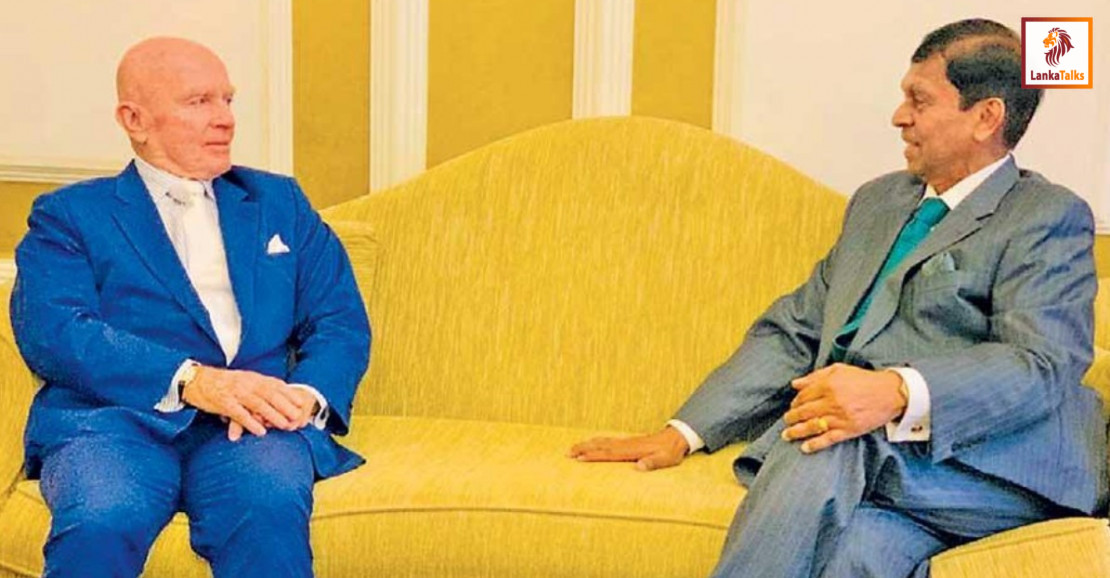
The cornerstone of Templeton’s massive exposure was a series of high-level discussions between Mark Mobius and then-Central Bank Governor Ajith Nivard Cabraal.
Cabraal’s strategy at the time was built on aggressive infrastructure development funded by foreign inflows and currency stability, with maintaining a soft-peg to ensure investor confidence.
Mobius was famously quoted during his visits to Colombo, emphasizing that the currency is based on confidence, not only on interest rates.
He believed that with the war over and the IMF backstop in place, the Sri Lankan Rupee would remain stable.
This belief was reinforced by personal assurances from the Central Bank leadership that the exchange rate would be managed to prevent the haircuts that foreign investors often fear in emerging markets.
“I think we’re pretty much over the big devaluation of the currency,” Mobius remarked during one of his definitive interviews in Colombo.
“Looking forward, it’s about the implementation of reforms. The currency will probably stabilize,” he said.
“Next big investment frontier”
Mobius was a frequent visitor to Sri Lanka, often seen navigating the streets of Colombo and meeting with top corporates like John Keells Holdings.
He didn’t just look at spreadsheets; he looked at the ground.
He famously noted the rapid influx of Chinese-funded infrastructure and the rising skyline as indicators that Sri Lanka was “the next big investment frontier.”
His investment philosophy for Sri Lanka was rooted in three specific factors: liquidity, foreign exchange control, and the direction of the currency.
While Mobius eventually diversified into private equity and equities, taking stakes in local blue-chip companies, his legacy in Sri Lanka will always be defined by those Treasury bonds.
He proved that a frontier market, recently emerged from conflict, could attract real money from Wall Street if the narrative of stability was sold effectively.
Complex Legacy
In later years, Mobius’s optimism was tested.
The soft-peg policy he supported eventually came under immense pressure, leading to the currency depreciations he had once predicted would not happen.
However, Mobius remained a permabull on the island’s potential.
Even during the economic turbulence of the late 2010s, he returned to Colombo, urging the government to lower interest rates and focus on digitalization.
His passing marks the end of an era for Sri Lankan finance.
He was the first global titan to treat Colombo not as a war-torn outpost, but as a legitimate destination for billions of dollars in global capital.
For the policymakers of 2009, he was the ultimate partner; for the investors who followed in his footsteps, he was the man who proved that in the world of high-risk bonds, fortune often favours the bold.
As executive chairman of Templeton Emerging Markets Group, where he worked for over 30 years, Mobius traveled relentlessly, often visiting dozens of countries in a single year in search of undervalued businesses and underappreciated economies.
He claimed to have visited at least 112 countries.
He became, in effect, the public face of emerging-markets investing just as the asset class was taking shape.
His calm manner and encyclopedic knowledge reassured Western investors who were uneasy about political risk, currency volatility, and opaque governance.
Born to Puerto Rican and German parents in Hempstead, New York, Joseph Bernhard Mark Mobius received a Ph.D in economics from MIT in 1964 with a thesis about communication satellites.