


 Breaking News
 Tracy
Tracy Tracy
Tracy Jul 06 2026
 810
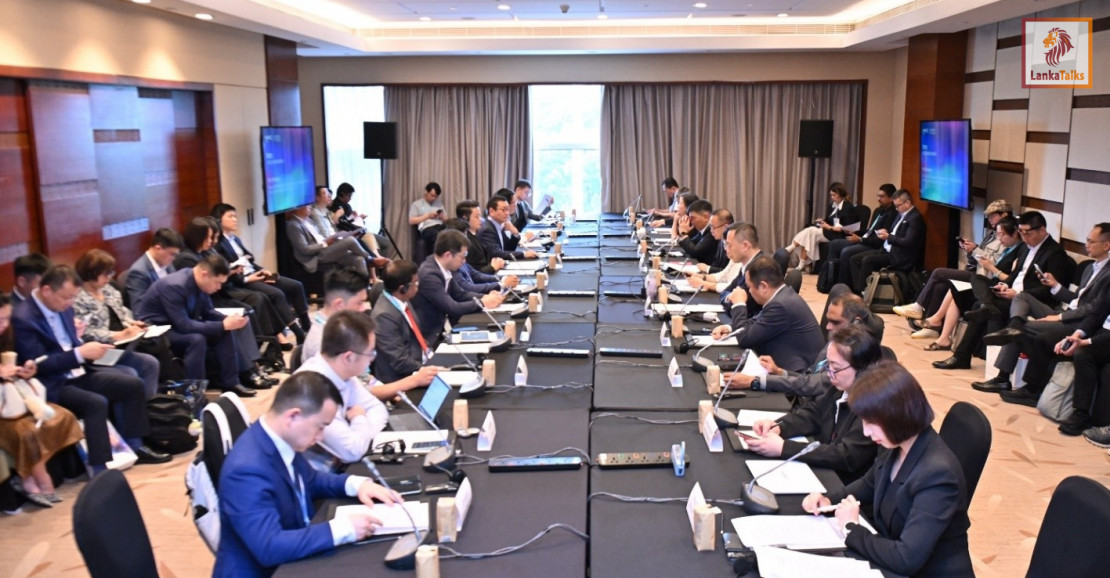
810On June 25, 2026, during MWC26 Shanghai, Sri Lanka's Ministry of Digital Economy joined the "Asia-Pacific Computing-Network Synergy Roundtable," hosted by the GSMA. Eng. Eranga Weeraratne, Deputy Minister of Digital Economy of Sri Lanka, took part alongside government officials from China's Ministry of Industry and Information Technology and Thailand's Ministry of Digital Economy and Society, representatives from international organizations such as the ITU Asia-Pacific Regional Office and the GSMA, executives from telecommunications operators including China Mobile, CTM Macau, Time dotCom (Malaysia), and Globe (Philippines), leaders from tech enterprises such as Kuaishou, MiniMax, StepFun, Huakun Zhenyu, and Huawei, as well as representatives from the Shanghai Artificial Intelligence Association. The participants convened under the theme "Powering the AI Economy" to discuss the evolution of digital infrastructure in the AI era and to build broad consensus.
The roundtable focused on the hot topics and pain points of computing-network synergy in the Asia-Pacific region, spanning policy strategies, technological innovation, industry practices, and ecosystem cooperation. Participants shared cutting-edge insights and actionable solutions based on the realities of the Asia-Pacific region, effectively strengthening industrial synergy. The meeting created a high-quality industry exchange platform and provided a powerful reference for the upgrade of digital-intelligence infrastructure and the co-construction of a computing-network ecosystem in the Asia-Pacific.
Eng. Eranga Weeraratne, Deputy Minister of Digital Economy of Sri Lanka, stated that in the AI era, smaller economies must make a choice: whether to be only as "Consumers of intelligence" or also, selectively, become "Producers of it". Sri Lanka has chosen to produce: sovereign where it matters, global for the rest, building it through the synergy of computing and network, in partnership with the region.
Si Han Bo CHEN, Head of GSMA Greater China, stated in her opening remarks that the focus of infrastructure competition has upgraded from "Universal Connectivity" (Connectivity of Everything) to "Computing scheduling and synergy." Single network coverage or isolated computing clusters can no longer meet the demands of large model training, real-time inference, and industrial transformation. Computing-network synergy has become the core foundation supporting the industrialization of AI and the AI-driven transformation of industries. With the world's most active technology innovation ecosystem, a massive digital consumer market, and rich industrial application scenarios, the Asia-Pacific region has transformed from a technology "follower" to a "leader" in new infrastructure construction and computing-network synergistic innovation. This roundtable gathered all parties for in-depth discussions on how to achieve synergy between computing power and networks, effectively moving AI computing power out of server rooms and into industries to serve all sectors of the economy.
Zhai Haipeng, Vice President of Huawei's Optical Business Product Line, expounded on the urgency and core paths of "computing-network synergy" in the AI era. He stated that AI is driving networks to evolve toward ultra-low latency (millisecond-level, from 5ms to 1ms), higher reliability standards (99.999% or even 99.9999%), and larger bandwidth. Regarding computing-network synergy in the Asia-Pacific, he combined the AI-oriented network architecture ION-2030 released by ITU-T to propose key goals for accelerating AI development and achieving "AI for all," including cross-border submarine/land cable synergy, building deterministic low-latency networks (1-5-20ms latency circles), and an ultra-gigabit strategy.
He Xiaowen, Deputy Director-General of Department of Planning, China’s MIIT, shared China’s strategic layout for computing and network integration. The nation views computing-network synergy as a core lever for upgrading new digital infrastructure, proposing development goals of a "3-tier architecture" (national, regional, urban) and "3-tier connectivity" (high-speed cross-regional direct links). China is deploying key technologies such as all-optical networks, 400G/800G, SRv6, and intelligent computing orchestration, committed to breaking down "computing silos." China is advancing a "millisecond" computing special action to create deterministic, low-latency networks, aiming to achieve millisecond-level interconnection of computing centers, millisecond-level access to computing resources, and millisecond-level reach for computing applications. Regarding the Asia-Pacific region, he proposed deepening regional alignment, continuously improving the cross-border Internet interconnection system through standardized interoperability and resource sharing, expanding international submarine and land cables, and enhancing the smooth flow of data across the Asia-Pacific. "Computing power empowers the future, networks connect us all, and synergy achieves win-win results" he added.
Dr. Atsuko Okuda Regional Director, International Telecommunication Union (ITU) Regional Office for Asia and the Pacific, presented ongoing ITU’s work in Asia and the Pacific within the framework of the successfully concluded World Telecommunication Development Conference (WTDC), held in Baku, Azerbaijan, in November 2025. Her presentation noted ongoing infrastructure and network expansions and upgrades in Asia and the Pacific together with ITU’s work on statistics and regional initiatives.
Citing studies on rapidly increasing demand for data and computing power due to AI rollouts, telecom operators are expected to carry out large-scale infrastructure upgrades, including network fiber optic expansion, backbone network expansion, and further densification of 5G sites. At the same time, it calls on countries to refer to the more than 200 AI-related standards developed at ITU, when deploying AI, to ensure interoperability and reliability of AI systems. It also points out that despite the rapid development of AI, some people have yet to connect or are under connected. While pursuing advances in AI computing power, countries must ensure that remote areas can also benefit from digital transformation through projects such as "Smart Cities, Smart Villages, and Smart Islands".
Daniel Shi, Global Business Account Executive of MiniMax, shared how AI model companies can conduct deep cooperation with operators, including resource swapping/empowerment and wholesale distribution systems, to jointly address the computing power demands and commercial opportunities of the AI era. He pointed out that in the future, the networks of "Token operators" need to offer the Tbps-level ultra-large bandwidth, millisecond-level latency, zero-loss reliability based on OTN network, extreme elasticity based on SRv6, agile delivery, and full-domain security. He stated that operators are the most important partners for AI implementation and possess inherent advantages in the security sector, ensuring that "the black magic of the AI field must be held in the hands of the good guys."
The MWC26 Shanghai Asia-Pacific Computing-Network Synergy Roundtable concluded successfully, gathering authorities, international standard organizations, leading operators, and AI/computing giants from across the Asia-Pacific region.
The GSMA issued an initiative to the entire industry: Regulatory agencies in all countries should strengthen policy coordination and accelerate top-level planning for computing-network integration. Upstream and downstream enterprises in the industrial chain should break down technical, scenario, and regional barriers to jointly build unified and open technical standards for computing-network synergy. All sectors of industry, academia, and research should deepen joint research and tackle key bottlenecks in computing scheduling, high-speed interconnection, and data flow. All parties should join hands to build a normalized cooperation mechanism in the Asia-Pacific region to comprehensively promote the interconnection, universal sharing, and accessibility of computing networks. It is hoped that global industry colleagues will work together closely to build a new type of digital infrastructure that is efficient, intelligent, inclusive, and sustainable, fully releasing the development potential of the AI industry and empowering the long-term prosperity of the regional digital economy.