


 Breaking News
 Tracy
 Tracy
 Oct 21 2026
 22
Every year on 16 October, World Food Day asks the world to look at its plates and at the people who fill them. This year's theme, Innovate today to feed tomorrow, is a useful prompt for a sector that often talks about innovation in terms of machines and prices. For poultry producers in Sri Lanka, innovation has a more practical meaning. It is the way a bird is raised, what it eats, and whether a family can trust the label on the pack.
The scale of the challenge
The Food and Agriculture Organization (FAO) estimates that about 673 million people were undernourished in 2024, equal to 8.2 percent of the world's population. In Southern Asia, the prevalence of undernourishment fell from 7.9 percent in 2022 to 6.7 percent in 2024. That is real progress, but it still leaves a very large number of people in a region of nearly two billion without enough to eat. For many households, affordable and nutritious food remains a daily concern.
Animal protein is one of the most efficient ways to deliver essential nutrients in a modest serving, and chicken and eggs are among the most accessible sources for families on tight budgets. That is why the way poultry is produced matters beyond the farm gate. What matters is not only how much food reaches the market, but what that food is made of and how it was raised.
Sri Lanka's poultry sector has grown. According to the Department of Animal Production and Health (DAPH), poultry meat production rose from about 236,110 tonnes in 2023 to about 258,540 tonnes in 2024. Egg output increased from about 2,044 million eggs to about 2,953 million over the same period. Growth in volume is welcome, but it does not settle whether the industry can keep producing reliably, or how the food is raised.
Innovation starts with the feed
Feed sits behind those numbers. Government estimates published in 2022 put annual maize requirements for animal feed at about 700,000 tonnes. Domestic maize output across the two cultivation seasons of 2024 totalled 223,497 tonnes, according to DAPH, so imports fill much of the gap. Their timing, permits and cost shape what a farmer pays for every bag, and what a consumer pays for every kilogram of chicken.
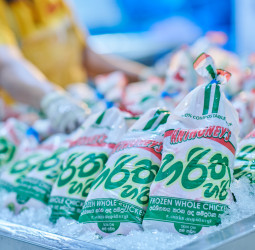
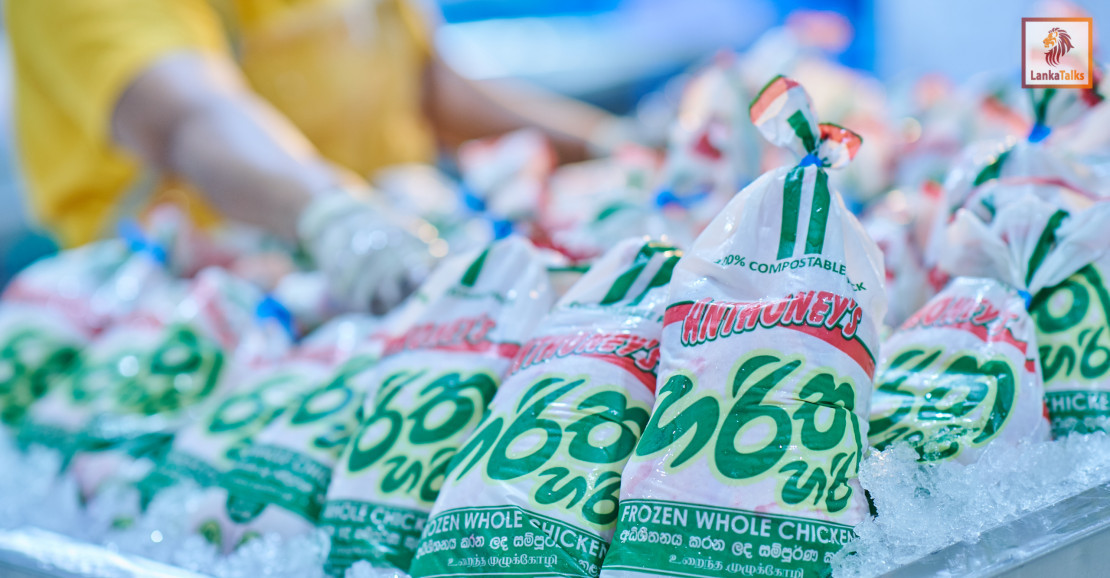
Innovation in poultry is often measured by speed and cost. We think it should also be measured by what goes into the bird. New Anthoney's Farms raises its birds without antibiotics, a choice that has forced the team to work harder on housing, biosecurity and nutrition. It is slower and more demanding than the conventional route. It also reduces pressure on a public health system already dealing with antimicrobial resistance, which the World Health Organization has described as a serious global threat.
Feed is where that discipline has to start. Our milling operation, Anthoney's Feeds, sits at the centre of how we think about quality. In 2023 the company was awarded rights to the Sustainable U.S. Soy logo, verified under the U.S. Soy Sustainability Assurance Protocol, and several other Sri Lankan producers and feed millers now carry the same standard. A label is only useful when it is trusted, so we treat it as a commitment to be audited, not a badge to display.
Innovation includes the farmer
Innovation is also about who gets to take part. Smallholder farmers already supply around 40 percent of New Anthoney's production through contract farming and outgrower partnerships. For a small farm, a known buyer, agreed terms and technical advice on biosecurity and flock management are as valuable as any new housing system. They help a family farm plan, invest and stay in the business through a difficult year.
That model also protects the wider industry. A farm that can plan its season is less likely to leave the sector when feed prices spike, and a supply base built on stable partners is easier to trace, audit and rely on. For a company that wants its label to mean something, those are the foundations, not side benefits.
South Asia shares the same exposure. Poultry industries across the region depend on imported feed ingredients, so price shocks move quickly across borders, and no single company can solve that alone. What can spread faster is a set of practices more producers adopt: traceable feed, responsible antibiotic use, fair terms for farmers and honest labelling for buyers. We would welcome more competition on those terms, because a more trusted category helps every producer in the market, including us.
Consumers are asking sharper questions than they were a few years ago. Where did this come from? What was it fed? Was anything added to make it grow faster? Those questions are reasonable, and younger households in particular are making purchasing decisions for their children on the strength of the answers. A producer that can answer plainly, with records behind the answer, earns a place on the shelf that price alone cannot secure.
Feeding tomorrow starts today
World Food Day is an easy day to make commitments, so we would rather show our work. That means being clear about how birds are raised, what they are fed, where the feed comes from and how many farmers are part of the supply base. It also means accepting that a claim is only as strong as the evidence behind it, and being ready to be checked.
Innovate today to feed tomorrow is not a slogan for one factory or one season. It is a test for the whole sector. The people who will eat the food produced over the next decade are already here, in Colombo, in the regional towns and in the homes where a chicken dinner is the most affordable way to feed a family well. The producers who will still be trusted when the next shock arrives are the ones taking the harder path now: cleaner feed, fewer shortcuts, fair partnerships with farmers and labels that can stand up to scrutiny. New Anthoney's is committed to that work, and we hope the rest of the industry will join us.