


 Breaking News
 Sheron
 Sheron
 Mar 06 2026
 745
745The ongoing military conflict in the Middle East has adversely impacted on the Sri Lankan tea industry as the exporters are unable to supply tea to the region. The exporters estimate the revenue loss at about $ 10-15 million per week. The exporters have orders in hand for supply of tea and it is the logistical issues and war risk preventing them fulfilling such orders.
Approximately 52% of Sri Lanka’s tea exports reach the region that mainly come from the low grown area of the country dominated by tea smallholder farmers. According to 2025 tea export statistics, about 125 million kilograms of Ceylon tea were exported to the Middle East, with an estimated value of USD 750 million. The major importing countries of Ceylon Tea in the region include Iraq, Iran, Libya, Turkey, Saudi Arabia, Syria, and the United Arab Emirates. Though Libya, Turkey can be reached via Africa the exorbitant freight charges have prevented the buyers in those countries from importing tea at the moment.
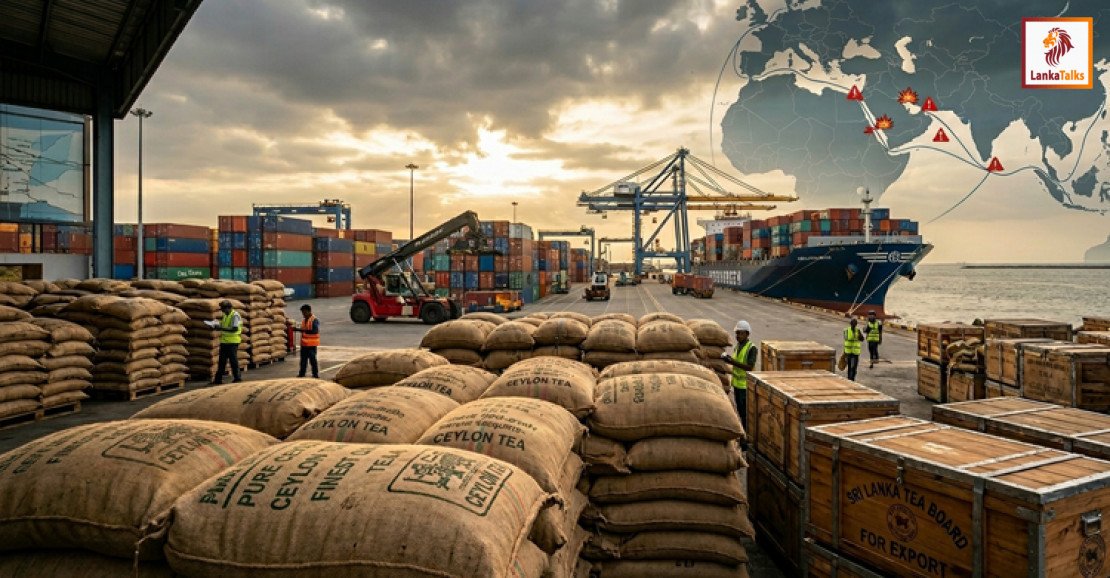
The supply routes to middle east countries go via Strait of Hormuz and Red sea Suez Canal. Although there is no blockade on Suez Canal, due to the war risk both channels are currently not used by the major shipping lines. The tea exports to the region have almost come to a standstill due to the following reasons:
- All major shipping lines suspended their services to the region immediately after the outbreak of the conflict.
- Several seaports in the region were temporarily closed during the initial stages.
- Although a few shipping lines resumed limited operations from 4th March, freight charges have increased significantly by approximately USD 1,800 for a 20’ container and USD 3,000 for a 40’
- Existing insurance coverage obtained by exporters is no longer valid.
- There is a lack of regular and scheduled vessels operating from Colombo to Middle Easterndestinations.
The tea exporters are experiencing serious cash flow constraints, as payments for shipments already dispatched have been delayed due to the unsettled situation in the region. This has restricted exporters’ buying capacity and that was evident at this week’s tea auction, where overall prices declined by about Rs. 50/ per kg while low grown tea prices declined by about Rs. 75/ per kg.
If the situation continues for few more weeks it will have a serious impact on the tea auction as buyers may curtail the purchase of tea if the outward movements are restricted. This could directly impact on the income of the tea smallholder farmers.
In January 2026, the country earned $ 121.8 million from tea exports compared to $ 112.7 million in January 2025 (a 5% increase). The figures for February 2026 are not yet available but should be either similar to last year or higher. The disruption to tea exports in March will certainly affect the volume and value of the exports though the exact amounts cannot be estimated at this point.
According to the available data Sri Lanka has settled about 95% of the debt to Iran by supplying tea to Iran under the Tea for Oil mechanism. Even if the military conflict comes to an end Sri Lanka will find it difficult to continue to supply tea to Iran unless a new mechanism is introduced. Under the prevailing US sanctions on Iran, the exporters may not be able to supply tea to Iran outside the barter system. Iran purchases about 11 million kg of tea from Sri Lanka annually under the barter deal.
The situation was discussed with the Minister of Plantation & Community Infrastructure at a meeting held on the 4th March 2026.
In order to mitigate the impact on the industry, the tea industry has jointly requested the government to support in addressing the cash flow issue and consider absorbing a part of the additional freight and insurance charges. It has also requested government intervention to obtain the balance payment of about $ 50 million due on tea shipments already made to Iran under the barter deal.
source: Adaderana Biz English