

 Breaking News
 A.R.B.J Rajapaksha
 A.R.B.J Rajapaksha
 May 21 2026
 47
47If foreign direct investment cannot be secured for the proposed 400-kilovolt (kV) transmission line connecting the North to Habarana — considered essential for integrating wind power renewable energy projects into the national grid — the Government may move ahead with the project using State funds, The Daily Morning learns.
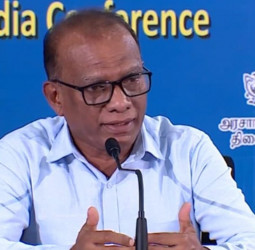
Commenting to The Daily Morning on the country’s renewable energy targets, Energy Minister Anura Karunathilaka said that some targets could be achieved within the planned timeframes, but acknowledged that there are also major infrastructure-related limitations affecting progress. “Some targets can be achieved. But, in some cases, the supporting infrastructure needed to connect renewable energy plants to the national grid is not available.”
Taking the significant wind power potential in Mannar and the Northern Province for example, he said that the region had a strong capacity for wind-based electricity generation, but that the transmission infrastructure required to transfer that electricity to the main national grid remains inadequate. “We especially need a 400-kV transmission line connecting the North to Habarana. The President told us that if we are unable to find direct foreign investment for this project, we should proceed even using Government funds.”
He further noted that the Government is simultaneously moving ahead with renewable power plant development through tenders involving private sector participation, while also working on expanding transmission infrastructure. “We can build power plants, building the required infrastructure takes time. However, we are continuously working to do both,” he added.
Speaking further, he said that Sri Lanka currently does not face major difficulties with electricity generation during daytime hours due to the growing contribution from solar power. “During the daytime, we don’t really have a problem. We generate a sufficient amount of electricity through solar power,” he said. However, he noted that some electricity still had to be generated from other sources during the day in order to maintain system stability and grid control. “Our current focus is on improving the energy storage capacity so that excess solar power generated during the daytime could be stored and used at night through battery systems.”
For a country like Sri Lanka, which has long depended heavily on imported fuel for electricity generation, expanding the renewable energy capacity is considered crucial for reducing fuel import costs, improving energy security, and limiting the exposure to global oil price fluctuations.
Source - The Morning