


 Breaking News
 Tracy
Tracy Tracy
Tracy Sep 13 2026
 591
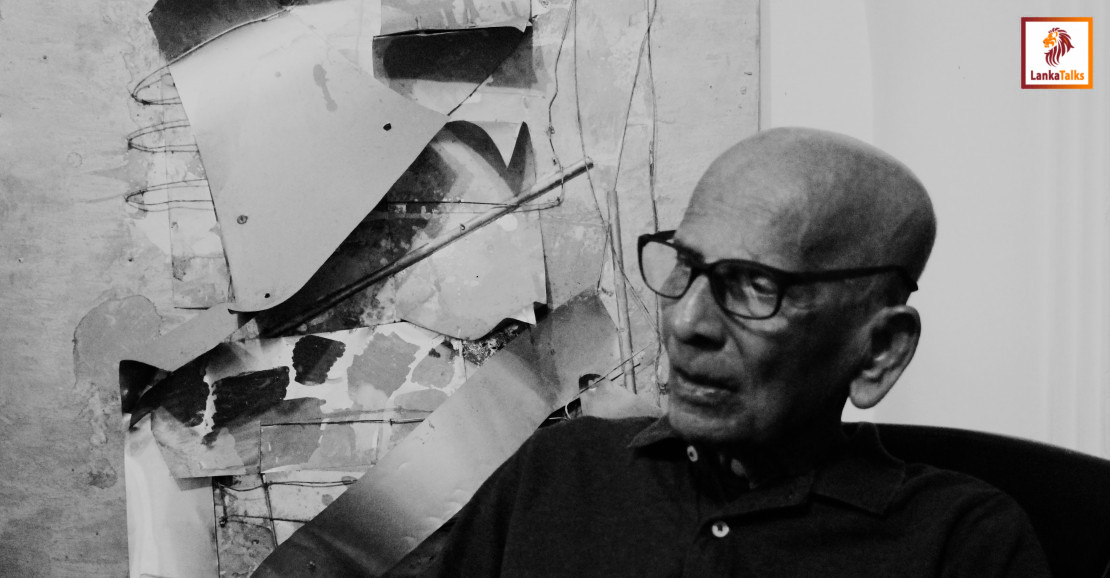
591H.A. Karunaratne is a contradiction in the realm of Sri Lankan art: although he is regarded as the father of abstraction by those familiar with his work, he remains unknown to a large segment of the general public. In order to fully grasp him, one must not merely look at the dates of his life; rather, his story is to be found in his artistic independence, in his refusal to adhere to the usual cultural trends, and in the quiet authority which he exercised over successive generations of artists; it is a story based on instinct, discipline and a rare dedication to beauty.
Karunaratne was born in April 1929 and grew up in Kotalawela, Kalutara, a village inhabited by potters, blacksmiths and jewellery makers. The colours, shapes and textures offered by these artisans had an early effect on his imagination. Even at the age of four, he was drawing on the lime-covered walls of his family's house, a thing which caused great annoyance to his parents. Though he was a hard-working student, his first teachers never fully realised his talent, and since he didn't receive formal instruction, he taught himself to paint. When he eventually went to art college in Colombo in 1952, he was already determined to break with the established norms. Where other students painted realistic figures, he reinterpreted Buddhist monks using geometric squares and triangles. His classmates mockingly referred to him as “Picasso”, but the critics and teachers regarded the young artist's bold experiments as promising and hailed him as one of the “most promising of the brush wielders”.
That natural tendency to seek out form later made Karunaratne one of the most influential teachers in the country. At the Institute of Aesthetic Studies, which is now the University of Visual and Performing Arts, he never asked his students to copy him. He thought that art could not indeed be taught in a strict way; a teacher could do no more than "show the way". His lessons frequently started outside the studio. Wearing a simple T-shirt and taking the public bus, he would point out the soot stains on the ceiling, the moss, the rusted metal or the weathered surfaces, illustrating to his students how ordinary textures could serve as a starting point for composition.
In the studio, he always demonstrated by example; former students recalled the quick, spontaneous way he worked and how he encouraged them to appreciate texture and find the inner beauty in their materials. His advice was straightforward and easy to remember: “Don’t muddy your work.” By that, he meant something more than just using a clean palette; he was asking his students to preserve the clarity of the canvas, the honesty of the brushstroke and the purity of their own intuition. Instead of forcing a preconceived idea onto the surface, he told them to “let it paint”.
His art went through several definite stages, influenced by changes in his environment and by his growing spiritual interests. In the 1950s, Karunaratne began to move away from academic realism and experimented with how far figurative forms could be pushed into abstraction. The scholarship that brought him to Tokyo in 1959 was a major turning point; while immersed in Japanese culture, he studied printmaking and lithography and took in the principle of minimal form, the sense of immediate touch, and the quiet balance linked with Zen philosophy.
In 1965, he underwent another change when he went to New York on a Fulbright scholarship, where he was introduced to the strength of American Abstract Expressionism. Although he was influenced by the expressive energy of artists like Jackson Pollock and Mark Rothko, his fully developed abstract style did not merely copy theirs. While many American painters derived inspiration from the anxieties of the post-war period, the theme of Karunaratne's work was based on Buddhist concepts of impermanence and meditation. Just as he did with corroded barrels and surfaces covered in moss, he incorporated local and global influences into a form that was clearly his own.
The freedom that formed the basis of Karunaratne's status as an artist meant pursuing a rapid, spontaneous process, guided by instinct yet controlled by years of observation. He would directly fasten ordinary materials such as wire, burnt paper and metal to his canvases, thus expanding the range of what painting could contain.
His contribution to modernism has now received important international recognition. Frieze Masters London invited Saskia Fernando Gallery to present a solo exhibition of his work, making it the first Sri Lankan gallery to show at the leading global art fair. Presented in the fair’s respected Spotlight section, the exhibition focuses on his early abstract works and his bold use of unusual materials. It also makes Karunaratne the second Sri Lankan artist to be featured at Frieze Masters, placing his work within the broader international history of modern art.
For a modern and contemporary Sri Lankan artist to be shown in this space is a significant achievement, challenging the geographic and cultural limits that have long kept South Asian abstraction on the margins. It affirms that Sri Lanka’s modernist movements possess the depth, originality and lasting value to be considered alongside major developments in global art history.
The presentation at Frieze Masters London will feature H.A. Karunaratne’s early works from 1950 to 1970. Alongside this international presentation, Saskia Fernando Gallery and LYNEAR Wealth are excited to contribute to Sri Lanka’s thriving art ecosystem and broaden appreciation of Sri Lankan modernist art.
The partnership brings together Saskia Fernando Gallery’s curatorial expertise with LYNEAR Wealth’s perspective on long-term wealth creation. For LYNEAR Wealth, it is more than connecting collectors with art; it is about contributing to a globally recognised art ecosystem. Dr H.A. Karunaratne’s presentation at Frieze Masters represents an opportunity for Sri Lankan modernism to gain international recognition. Through this partnership, we look forward to supporting greater institutional engagement and a growing community of artists, collectors and patrons.