


 Breaking News
 Tracy
Tracy Tracy
Tracy Mar 28 2026
 938
938Sri Lanka’s export sector sustained its recovery momentum in February 2026, with total exports, including both merchandise and services, reaching US$ 1,401.78 million, reflecting a 4.22% year-on-year increase, according to provisional data.
Merchandise exports recorded a modest growth of 1.32% to US$ 1,066.88 million. In contrast, services exports continued to expand strongly, rising by 14.68% to an estimated US$ 334.9 million, underscoring the increasing importance of the services sector in Sri Lanka’s export portfolio.
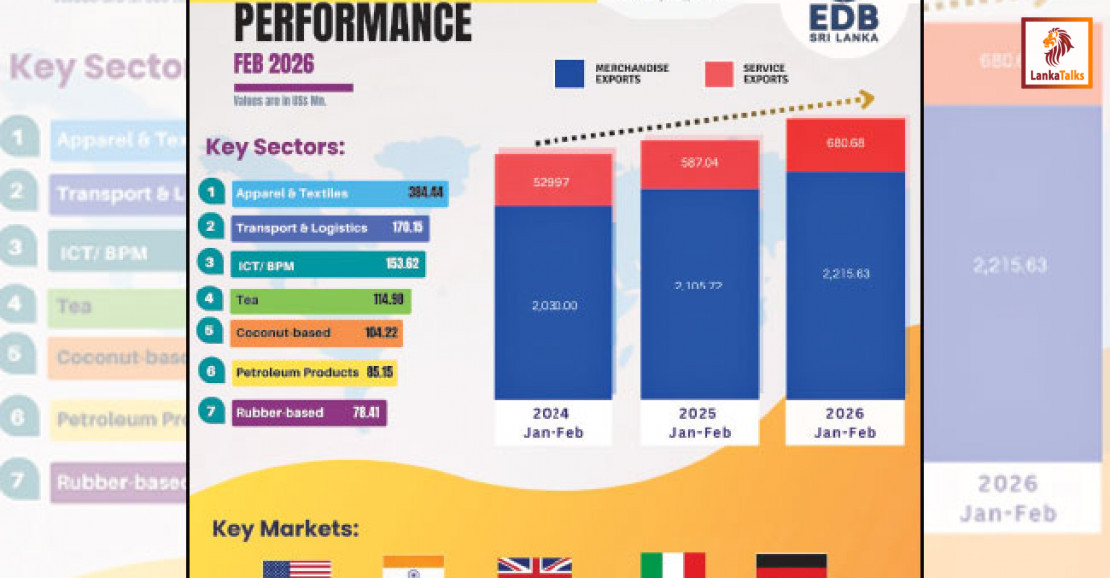
On a cumulative basis, total exports for the period January–February 2026, is estimated at US$ 2,896.31 million, marking a notable growth of 7.56% compared to the same period in 2025. Merchandise exports during this period increased by 5.22% to US$ 2,215.63 million, while services exports recorded a robust growth of 15.95% to US$ 680.68 million.
Export Development Board (EDB) Chairman and Chief Executive Officer Mangala Wijesinghe said the February performance signals a positive trajectory toward achieving annual export targets. He noted that the growth reflects improving global market conditions, sustained industrial output and the impact of targeted export development initiatives.
Among key sectors, coconut-based products emerged as a strong growth driver, with export earnings increasing by 25.22% year-on-year. Significant gains were recorded in coconut oil, coconut cream and activated carbon, highlighting enhanced value addition and steady global demand. The food and beverages sector also performed strongly, expanding by 36.36%, largely driven by processed food exports.
Electrical and electronic components recorded a notable increase of 54.37%, supported by rising demand for transformers and electrical equipment. Meanwhile, spices and essential oils grew by 3.98%, boosted by a sharp increase in cinnamon exports. In the services sector, ICT/BPM exports surged by 36.66%, further strengthening Sri Lanka’s transition toward a knowledge-based economy.
However, several traditional export sectors experienced declines. Tea exports fell by 3.71% to US$ 114.98 million, mainly due to reduced demand from key markets such as Russia. Apparel and textiles declined by 10.03%, reflecting weaker demand in major markets including the United States and the European Union. Rubber-based products and seafood exports also recorded contractions during the month.
In terms of markets, the United States remained Sri Lanka’s largest export destination despite a marginal decline, while India consolidated its position as the second-largest market with notable cumulative growth.
Overall, Sri Lanka’s export performance highlights the sector’s resilience and gradual diversification, supported by stronger services exports and emerging product segments, despite ongoing global economic uncertainties and geopolitical challenges.
Source: Daily News