


 Breaking News
 Tracy
Tracy Tracy
Tracy Oct 02 2026
 644
644IMF’s Dr. Woldemichael says more time needed for Sri Lanka’s seventh review discussions while Central Bank Governor Dr. Weerasinghe stresses stability as foundation for growth
Sri Lanka’s transition from economic stabilisation to its next phase of sustainable growth took centre stage at the Sampath Bank Economic Forum 2026, where IMF Resident Representative for Sri Lanka Dr. Martha Tesfaye Woldemichael outlined the progress made under the IMF-supported programme while highlighting the reforms and policy priorities needed to sustain momentum.
Hosted by Sampath Bank PLC on 24 September at Shangri-La Colombo under the theme “The Great Reordering: Global Shifts, Market Opportunities and Sri Lanka’s Next Growth Chapter”, the Forum brought together policymakers, economists and business leaders to examine Sri Lanka’s economic outlook amid a rapidly changing global environment.
A key discussion centred on the ongoing seventh review of Sri Lanka’s Extended Fund Facility (EFF) programme and the absence of a staff-level agreement following the IMF’s latest mission. Clarifying the significance of the development, Dr. Woldemichael said the absence of an agreement at the mission stage does not necessarily indicate that the programme is off track, noting that discussions can require additional time to reach agreement on key policies and parameters. The IMF subsequently confirmed on 23 September that discussions with the authorities were continuing towards concluding the seventh review. She hailed the success of the current program with almost 85% of the total program objectives achieved, and highlighted the need to continue on the reform agenda.
However, she also addressed concerns surrounding proposed amendments to Sri Lanka’s Anti-Corruption Act, stressing that the IMF’s concerns about certain provisions should not be interpreted as diminishing the significant governance reforms already implemented under the EFF programme. Dr. Woldemichael noted that the IMF supports reviewing the legislation based on implementation experience, while raising concerns that some proposed amendments could weaken transparency and accountability, particularly in relation to public access to asset declarations, redaction rules and the scope of asset declarations. The IMF has similarly stated that preserving the integrity of the anti-corruption legislative framework remains critical to public trust.
Dr. Woldemichael described Sri Lanka’s macroeconomic progress as significant, pointing to sustained growth, lower inflation, stronger tax revenue, a positive primary balance and substantial progress on debt restructuring. She emphasised that the next challenge is moving from stabilisation to transformation through reforms that improve the business environment, attract investment, expand exports and generate durable growth.
Sri Lanka’s Central Bank Governor Dr. P. Nandalal Weerasinghe said maintaining macroeconomic and financial stability remains essential as Sri Lanka moves into its next phase of growth. He pointed to the importance of continued reserve accumulation and stronger buffers to withstand external shocks, while noting that monetary policy would remain data-driven and focused on maintaining price stability under the flexible inflation targeting framework.
Dr. Weerasinghe also highlighted the need to address administrative bottlenecks, licensing and permitting, digitalisation and trade barriers to create a more supportive environment for businesses. He stressed that a stable monetary and financial system, supported by a well-capitalised banking sector, provides businesses with greater predictability to invest and grow, while reforms that improve access to regional and global markets can strengthen Sri Lanka’s competitiveness.
The Forum also featured more key insights from Dr. P. Nandalal Weerasinghe and Dr. Martha Tesfaye Woldemichael, with the welcome address delivered by Hiran Cabraal, Independent Non-Executive Director of Sampath Bank PLC. The panel discussion, moderated by Tharindu Abeywardana, Chief Economist and Head of Research at Sampath Bank PLC, further examined Sri Lanka’s growth prospects and the implications of global economic shifts.
Closing the Forum, Sampath Bank Managing Director and Chief Executive Officer Sanjaya Gunawardana emphasised that Sri Lanka’s progress now requires collective action. He called on policymakers, businesses and financial institutions to work together to convert emerging opportunities into sustainable growth, reaffirming Sampath Bank’s commitment to partnering with stakeholders as the country enters its next chapter of economic development.
Photo caption:
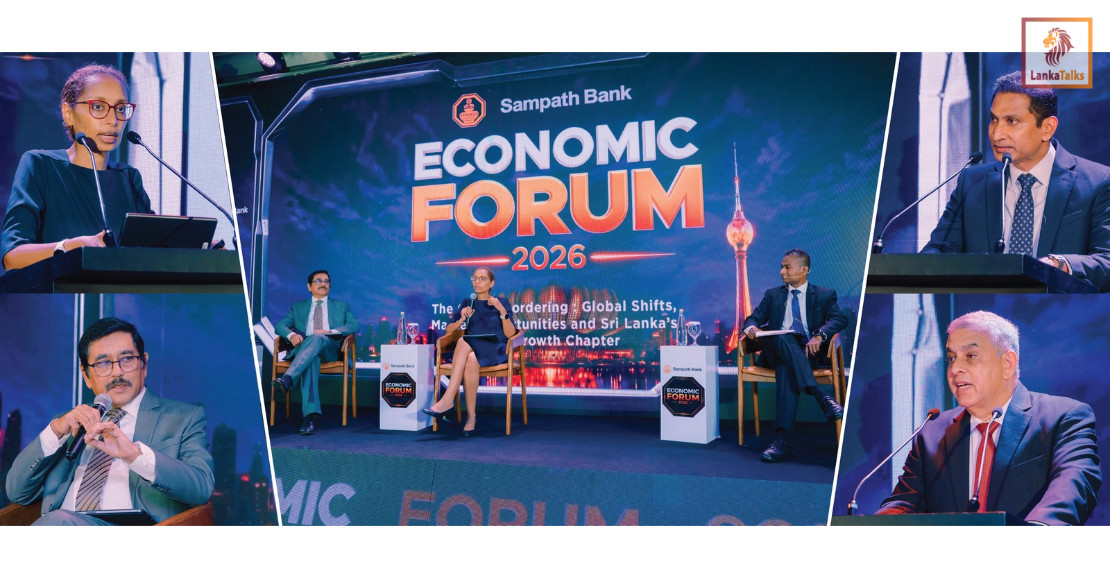
Image 1: Dr. Martha Tesfaye Woldemichael, IMF Resident Representative for Sri Lanka (top left); Dr. P. Nandalal Weerasinghe, Governor, Central Bank of Sri Lanka (bottom left); Sanjaya Gunawardana, Managing Director and Chief Executive Officer, Sampath Bank PLC (top right); and Hiran Cabraal, Independent Non-Executive Director, Sampath Bank PLC (bottom right). The centre panel captures the Forum discussion featuring Dr. P. Nandalal Weerasinghe, Dr. Martha Tesfaye Woldemichael and moderator Tharindu Abeywardana, Chief Economist and Head of Research, Sampath Bank PLC.