


 Breaking News
 Tracy
Tracy Tracy
Tracy Dec 16 2025
 808
808Kelani Valley Plantations PLC invited to be Patron of the Water & Ocean Stewardship Working Group of UN Global Compact Network Sri Lanka
In a world gasping under the weight of its own carbon footprint, where floods wash away futures and droughts rewrite destinies, sustainability leadership can no longer be a lofty ambition - it must be a grounded commitment. Nestled in the heart of Sri Lanka’s lush landscapes, where the whispers of the Kelani River weave through verdant estates, a quiet revolution is taking root. Kelani Valley Plantations PLC (KVPL), a beacon of sustainability and ethical agribusiness, has stepped forward as the Patron for the Water & Ocean Stewardship Working Group of UN Global Compact Network Sri Lanka (Network Sri Lanka). This is not just a title; it is a testament to KVPL’s unwavering commitment to environmental stewardship, a journey that began long before this recognition and will continue far into the future.
A Legacy of Sustainability
"We don’t just grow tea, rubber, or coconut. We grow value. We grow accountability. And we grow our future," says Dr. Anuruddha Gamage, Head and General Manager of HR and Corporate Sustainability at KVPL. Indeed, KVPL’s legacy is not merely agricultural, it is environmental. In 2006, they became the first Sri Lankan plantation company to sign the Ten Principles of the UN Global Compact. Two years later, they aligned with the CEO Water Mandate. In a sector once defined by monoculture and extraction, KVPL has pioneered a regenerative, research-led model of agribusiness that balances ecological integrity with economic necessity.
KVPL’s internal framework, called its Corporate DNA, aligns Environmental, Social, and Governance (ESG) pillars with global goals and ground realities. "We’ve never stepped away from this commitment," says Dr. Gamage. "Every year, we’ve shown improvements - not just in reporting, but in real, measurable impact."
Where Business Begins with Water
The landscapes of KVPL’s estates are a testament to the intrinsic connection between business and nature. Dr. Gamage emphasizes; "Without water, without plants, without soil, we cannot have our business." This profound understanding drives KVPL’s relentless efforts to conserve and restore resources. Historically, the plantation industry saw water as infinite, flowing endlessly from the mountains. KVPL has transformed this mindset through continuous training, awareness, and partnerships. "We have made our team understand that water is not just a resource; it is a critical limiting factor," Dr. Gamage explains. This shift in perspective has been instrumental in driving KVPL’s water stewardship initiatives. The project was implemented at the Dunedin Skim Rubber Factory of Kelani Valley Plantations PLC, a leading producer of skim rubber in Sri Lanka. Its primary objective was to identify methods to reduce freshwater consumption and wastewater generation during the skim rubber milling process. Freshwater usage at each stage of production was measured, revealing a total daily requirement of approximately 30,000 liters.
An analysis of water quality parameters across various discharge points indicated that the effluent from the smooth mills could be reused following a simple pretreatment process. Accordingly, milling water from the smooth mills was segregated through a dedicated drainage system and collected in an intermediate tank after undergoing filtration and sedimentation. The treated water was then pumped via PVC pipelines and stored in a metal tank for reuse.
With the implementation of this new protocol, the factory’s daily freshwater requirement was reduced by 15,000 liters - representing a 50% reduction. Furthermore, total wastewater generation decreased by 19%. Based on the factory’s current water usage patterns, the initiative has resulted in an annual saving of approximately LKR 15.6 million in wastewater transport costs. The project required an initial investment of LKR 316,000, which was fully recovered within just five days.
From Policy to Planting
The Kelani Valley Protectors Initiative (KVPI), launched under the National Surakimu Ganga Programme, is a prime example of KVPL’s leadership. This multi-stakeholder partnership protects water sources, plants native tree species, and engages local communities through green clubs. "We have planted more than 4,500 [KR1] plants and logged over 8,000 volunteer hours on water conservation initiatives," Dr. Gamage notes with pride.
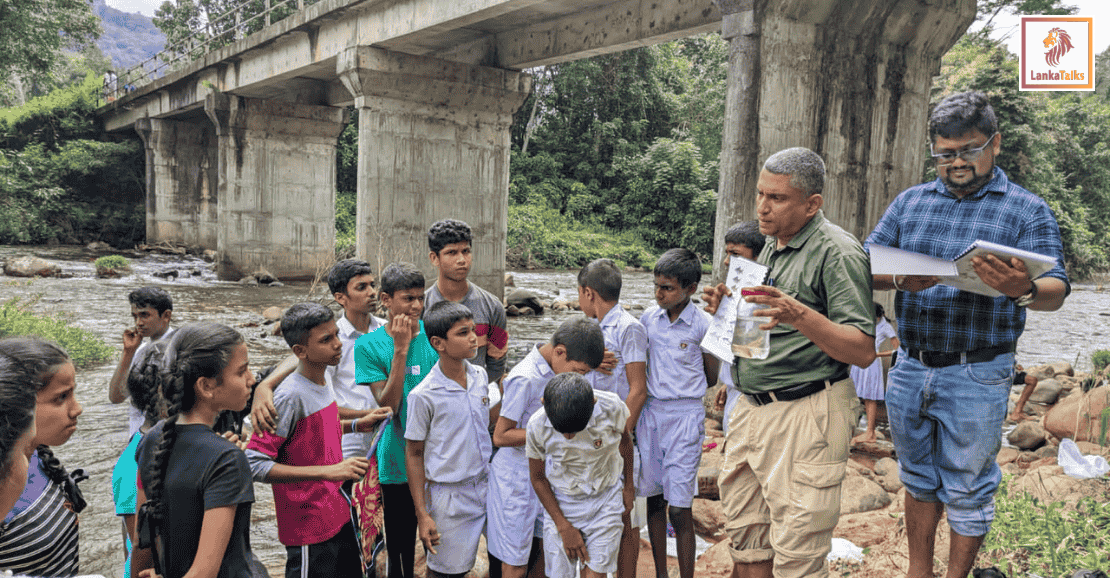
What sets KVPL apart is its multi-layered approach to sustainability. It bridges science with grassroots engagement. In remote estate communities, KVPL has established Green Clubs in schools, empowering children to become environmental ambassadors in their households. "Sometimes the science is too complex to communicate directly. But if you teach a child, that child becomes a bridge," Dr. Gamage reflects.
The Ethics-Economy Equation
KVPL’s philosophy rests on four pillars: product quality, ethical business, environment, and social responsibility. "Environment is one of the key parameters in our business philosophy," Dr. Gamage asserts. This holistic approach ensures that KVPL’s financial performance is inseparable from its environmental and social impact.
As Patron for Water & Ocean Stewardship, KVPL now has a platform to amplify its decades of water conservation and climate resilience work. "We want to be a practical example to others, to learn from us and for us to learn from them," Dr. Gamage explains.
Here, the role of Network Sri Lanka has been transformative. By linking KVPL to global water stewardship frameworks, capacity-building tools, and peer companies, the Network has sharpened KVPL’s strategies in watershed management and community engagement. It has helped KVPL strengthen its reporting, gain international credibility, and more importantly, provided a collaborative platform where lessons from the plantation sector can inspire water stewardship across industries.
Scaling Up, Linking Up
KVPL’s ambitions are firmly aligned with the UN Sustainable Development Goals (SDGs), particularly SDG 6: Clean Water and Sanitation, SDG 13: Climate Action, and SDG 17: Partnerships for the Goals. Long-standing collaborations with institutions in Japan, Poland, India, Malaysia, and Singapore have broadened KVPL’s capacity to share and absorb global knowledge.
The future, as Dr. Gamage puts it, is about “scaling up and linking up.” "If Sri Lanka’s corporate sector doesn’t step up now, we risk becoming irrelevant in a world that’s shifting rapidly toward sustainability," he warns. "But if we work together, across sectors and silos, we can lead - not lag."
A Shared Future
KVPL’s journey is a call to action for all stakeholders - businesses, governments, NGOs, and communities - to unite in addressing the twin crises of water security and climate resilience. "This is a national responsibility, and we are committed to making a difference," Dr. Gamage stresses.
In his words: "We are not just a plantation company; we are an agribusiness venture. Our business is with nature, and we cannot forget that." With the platform provided by Network Sri Lanka, KVPL is not only deepening its own sustainability practices but also ensuring that its lessons ripple outward, inspiring others to act.
Kelani Valley Plantations PLC stands as a beacon of hope, a testament to the power of commitment, and a pioneer in water and ecosystem stewardship. Together with the UN Global Compact Network Sri Lanka, KVPL is not just envisioning a sustainable future; they are creating it.