


 Breaking News
 A.R.B.J Rajapaksha
 A.R.B.J Rajapaksha
 Apr 10 2026
 842
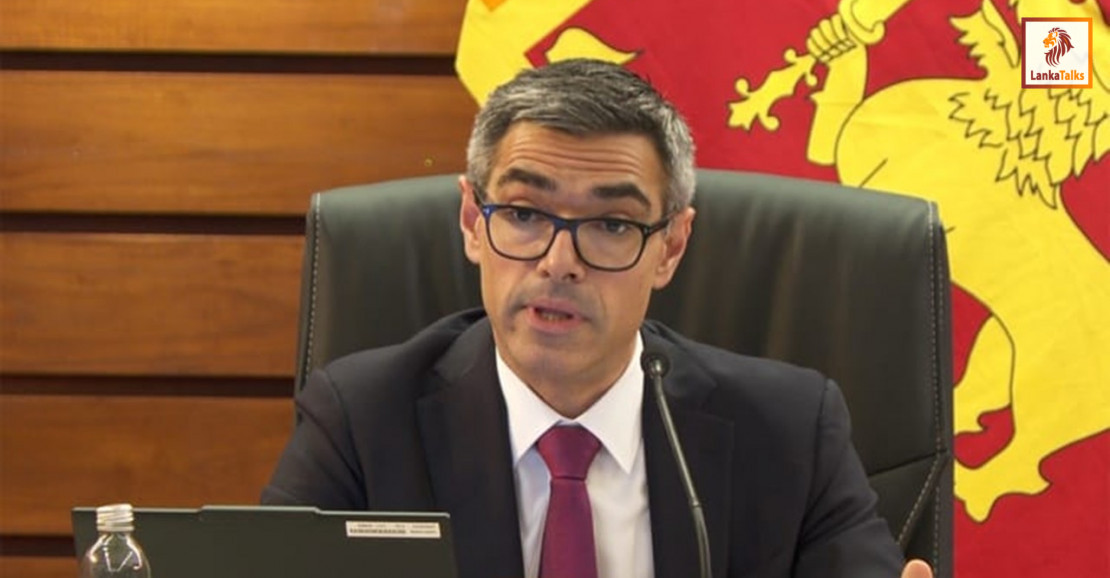
842Sri Lanka’s adherence to expenditure parameters as set in the Public Financial Management Act is crucial, as it rebuilds itself amidst a globally volatile situation in the Middle East, which has led to further reliance on its fiscal space in the meantime to counteract exogenous shocks, International Monetary Fund (IMF) Mission Chief to Sri Lanka Evan Papageorgiou said yesterday (9).
“As Sri Lanka starts building back better, projects should be prioritised judiciously and spending executed transparently and in compliance with the Public Financial Management Act. Any fiscal support in response to exogenous shocks should be well-targeted, carefully costed, and timebound,” Papageorgiou said.
Sri Lanka’s Public Financial Management Act, No. 44 of 2024, Section 15(1) maintains that Sri Lanka must limit annual Government expenditure, excluding interest payments on debt within 13% of GDP, regardless of revenue levels. Sri Lanka is also meant to adhere to the primary expenditure limit of 13% of GDP, as part of its commitment to the International Monetary Fund’s Extended Fund Facility (EFF). However, if required, the Government is able to exceed the limit, as stated in the PFMA’s Section 14, 2 and 2(a).
In December of 2025, Deputy Minister of Finance and Planning Anil Jayantha Fernando said that with Sri Lanka’s preliminary allocation of Rs. 500 billion for reconstruction and recovery post-cyclone Ditwah, the primary expenditure balance limit of 13% of GDP is likely to be exceeded by 1-1.4% in 2026.
Based on indications made by Treasury officials during Committee on Public Finance (COPF) meetings which followed the catastrophe, Sri Lanka is to have earmarked $ 3.5 billion by now, or roughly Rs. 1,000 billion to Rs. 1.2 trillion towards recovery and reconstruction for the next three years.
“Protecting the poor and vulnerable, who are disproportionately affected, should remain a priority, and this calls for the steadfast strengthening of social safety nets by improving their targeting, adequacy, coverage, and shock-responsiveness,” Papageorgiou added.
On Tuesday, President Anura Kumara Dissanayake announced a Rs. 100 billion relief package for the next three months, which included a Rs. 60 billion allocated for fuel subsidies, a Rs. 1.7 billion fertiliser subsidy, and a Rs. 15 billion allocation for electricity bills.
It was also announced by the president that recipients of the social safety net welfare programme, Aswesuma were to see increased payments of up to Rs.25,000, per family.
“On this front, it is important to continue building fiscal space through strong revenue measures and prudent spending execution. This requires sustained efforts to improve tax compliance, broaden the tax base, address revenue leakages, and enhance public financial management.”
“It is instrumental to restore and maintain cost-recovery fuel and electricity pricing while assisting the most vulnerable. Continued vigilance is needed to minimise fiscal risks and safeguard fiscal discipline,” Papageorgiou said in his statement.
The IMF staff and Sri Lankan authorities reached staff-level agreement on the combined Fifth and Sixth Reviews under the 4-year Extended Fund Facility (EFF) arrangement, as announced yesterday, after which the IMF Executive Board is to give its final approval for the disbursement of $ 700 million, as the combined tranche for the Fifth and Sixth Review. The approval is contingent on two conditions: the restoration of cost-recovery electricity and fuel pricing while protecting the vulnerable, and the completion of the financing assurances review to confirm multilateral partners' financing contributions and adequate progress on debt restructuring, according to Papageorgiou.
Under the original timelines of the 4-year EFF programme approved on March 20 2023, the Fifth Review was supposed to take place in December of 2025, which alone was to unlock a sum of $347 million. Due to cyclone Ditwah and the ongoing war in the Middle East, the reviews were combined. The combined tranche value of $700 million is part of the original $3 billion programme approved back on March 20, 2023. So far, of the $3 billion the four year programme is to unlock, the latest disbursement is to bring the total disbursed sum to $2.4 billion.
“Upon completion of the Executive Board review, Sri Lanka would have access to (Special Drawing Rights) SDR 508 million (about $ 700 million), bringing the total IMF financial support disbursed under this arrangement to SDR 1,778 million (about $ 2.4 billion).
Source - The Morning