


 Breaking News
 Sheron
 Sheron
 Apr 07 2026
 1000
1000There is a particular kind of national anxiety that travels online before it ever reaches the front page. It starts as a question searched in the dark, becomes a post shared from a petrol queue at five in the morning, and ends as a comment under a news article that says simply, Aiyo. In March 2026, Sri Lanka had one of those moments. And the internet had a great deal to say about it.
When the Ministry of Energy reintroduced the National Fuel Pass, a QR-based fuel allocation system brought back to manage supply amid rising global oil prices, it triggered a wave of public conversation that spread rapidly across social media, news platforms, and digital commentary. Talkwalker, the global consumer intelligence platform, together with its exclusive partner for Sri Lanka and the Maldives, Mark and Comm, tracked that conversation as it happened. Every spike in volume, every shift in mood, every new theme and grievance found its way into the data. What it captured is not just a record of a policy rollout. It is a window into how Sri Lankans are feeling right now.
This piece draws on that data to map what people were saying, why they were saying it, and what it means for anyone whose decisions depend on understanding public sentiment in this country.
The Numbers Behind the Noise
The scale of the conversation is the first thing worth sitting with. In the 30-day period from early March to early April 2026, the National Fuel Pass generated over 3,100 online results and this number is only those that are publicly accessible, with total engagement across all that content reaching 64,100 interactions. These are not the kind of numbers that arrive quietly.
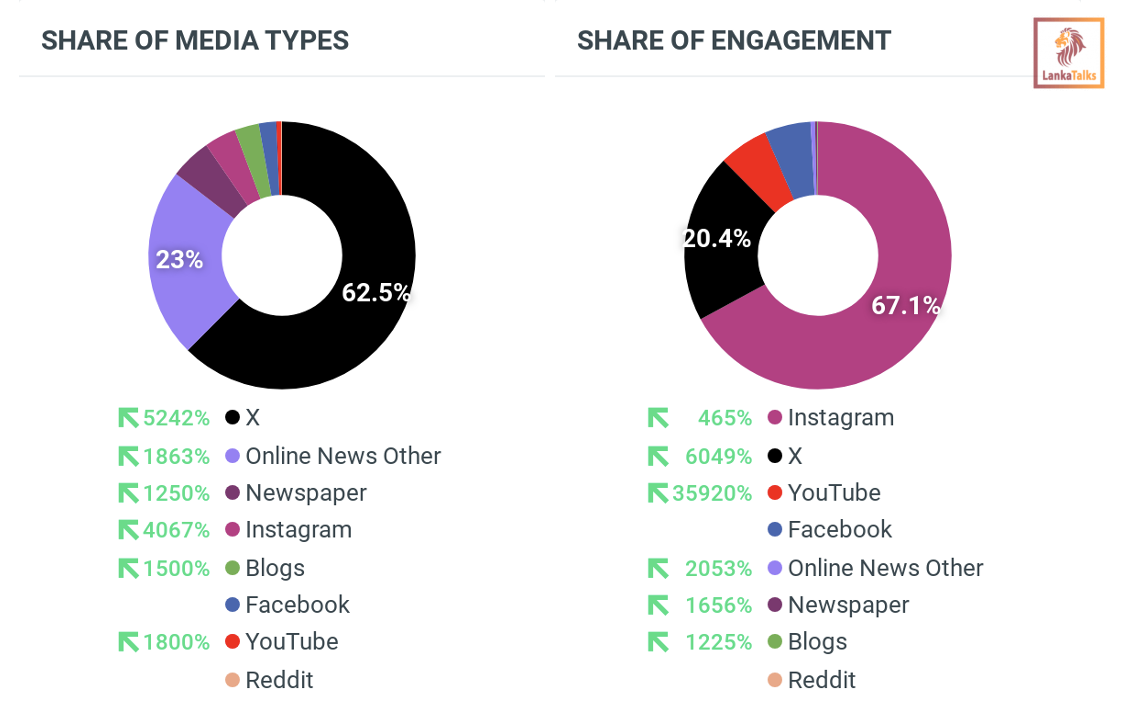
Share of media type and engagement, excludes significant Meta related private profile, groups, etc.
Of those results, 2,200 came from social media and 871 from news coverage. It is also important to note that social media would’ve actually been significantly higher as Meta doesn’t allow access to monitoring private profiles, groups and pages. The conversation was genuinely broad. The 853 unique authors who contributed to it came from right across the public. This was not a handful of vocal accounts driving a narrative. It was a wide cross-section of Sri Lankan voices, all speaking at once, about the same thing.
Numbers like these do not happen without a reason. They happen when something touches people's lives directly. Fuel does exactly that. It shapes the cost of the morning commute, the price of goods on the shelf, the ability of a small business to keep its vehicles on the road. When fuel becomes uncertain, conversation becomes unavoidable.
Three Spikes, Three Stories
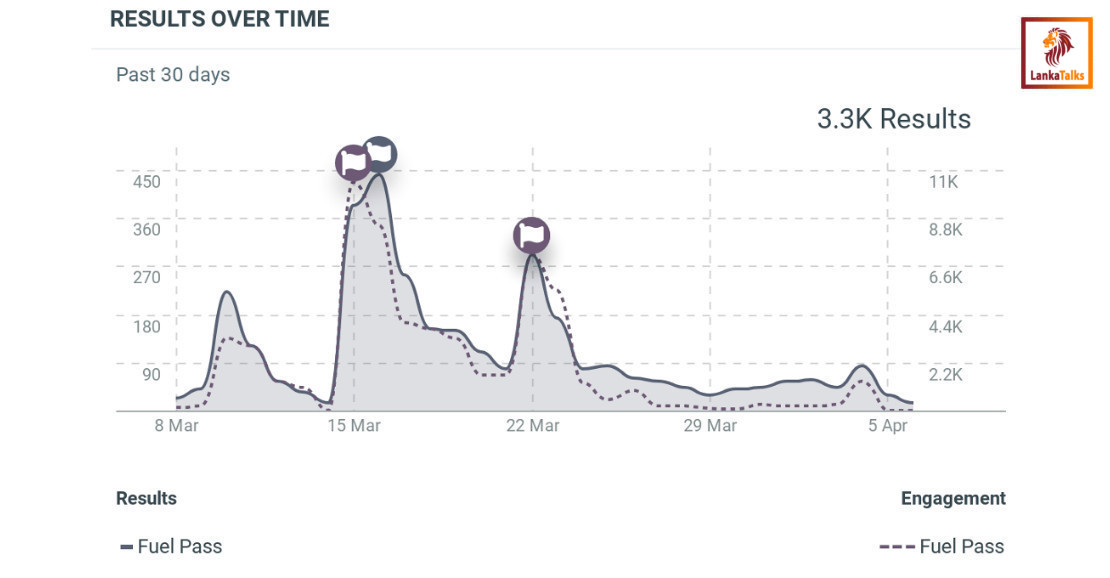
One of the most telling features of the data is its shape over time. Rather than a single wave of reaction, the conversation produced three distinct spikes across the 30-day period, each one tied to a specific moment in the unfolding story.
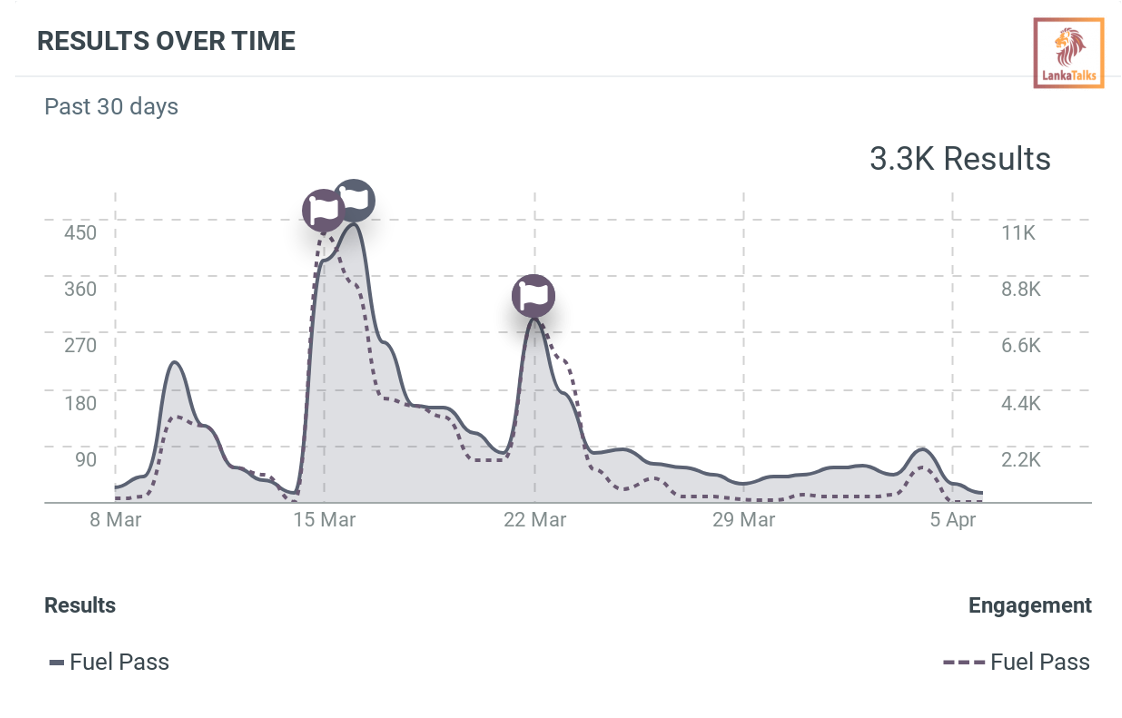
The three significant spikes during March around the fuel pass
The first and largest surge came around the middle of March, when the Fuel Pass system was formally reintroduced and weekly quotas were announced. The allocations were specific and immediate: motorcycles limited to five litres per week, cars and three-wheelers to fifteen, vans to forty, buses to sixty, and lorries up to two hundred. For many vehicle owners, seeing those numbers in black and white was the moment the situation became real. Social platforms filled quickly with questions, concerns, and no small amount of frustration.
The second spike followed as registration problems became widely reported. Second-hand vehicle owners found themselves locked out of the system, which kept flagging their cars and bikes as registered to previous owners. There was no easy fix. Many who called the helpline could not get through. One post summarised the experience bluntly: the system had been built on the assumption that nobody in Sri Lanka owns more than one vehicle. That observation landed hard and spread fast.
The third spike arrived toward the end of March, when another round of fuel price revisions was announced and warnings began circulating about fraudulent websites mimicking the official Fuel Pass platform. Criminal Investigation Department involvement was confirmed as individuals were found to have generated unauthorised QR codes. The conversation had by then moved from confusion and frustration into something closer to systemic distrust. People were not just unhappy with the policy. They were questioning whether the digital infrastructure holding it together could be relied upon at all.
What the Sentiment Data Shows
The sentiment picture is one of the most important things Talkwalker surfaces because it goes beyond what people said to capture how they felt. Over the 30-day window, positive sentiment sat at 8.2 per cent of classified content. Negative sentiment reached 29 per cent. The gap between those two figures tells its own story.
Registration barriers were the biggest single driver of negative feeling, particularly for owners of second-hand vehicles who were entitled to fuel allocations but could not access them. Many found the helpline unhelpful. The system was described repeatedly as broken, impossible, and unfair. Close behind was the fraud dimension: fake Fuel Pass websites appearing within days of the relaunch, warnings about phishing and data theft, and over 1,000 complaints about QR code misuse all contributed to a growing sense that the digital system had been rushed out without adequate safeguards.
The third driver was a feeling that government communication was falling short. Calls from opposition voices for full transparency on how fuel prices were being calculated, and for targeted relief rather than blanket measures, generated traction online. The broader economic cascade mattered too. Bus fares rose as transport operators absorbed higher costs. Container logistics jumped around 20 per cent. Farmers warned that rising diesel prices were threatening the harvest season. The fuel conversation was never just about fuel.
Underneath all of it sat the global picture. Fuel prices in Sri Lanka had risen by around 35 per cent since the outbreak of the Middle East conflict, implemented across two separate revisions. Crude oil had climbed sharply. Aviation fuel had followed. People understood this was not happening in isolation. What they struggled with was how the burden was being distributed, and whether those managing the situation were being straight with them.
The Language of the Moment
Beyond sentiment, the thematic data reveals what Sri Lankans were actually focused on. The dominant conversation themes across the 30 days included national fuel, fuel price, fuel costs, the east conflict, global fuel, fuel stations, pricing formula, fuel distribution, Sri Lanka, and higher fuel. Taken together, they paint a clear picture of a public that was deeply engaged with the issue on multiple levels.
What is striking about that list is not just what is in it but how it reads together. People were not simply reacting to a price change. They were thinking about how prices are decided, whether the distribution system is fair, what Sri Lanka's energy future looks like, and how the country connects to larger global forces. The public conversation was more layered and more informed than it sometimes gets credit for being.
New themes that emerged for the first time during the period included auto diesel, rising fuel, and prices increased. Individuals associated with the technical development of the QR system also began appearing in conversations, reflecting a public interest not just in whether the system worked but in who built it and who was responsible when it did not. Accountability, in other words, was a theme as much as fuel was.
The hashtag landscape told a similar story. Fuel-related tags dominated, as expected, but cybersecurity tags and transparency tags also appeared, signalling a public that was not just venting but organising its concerns into recognisable categories. That is a meaningful distinction.
What People Actually Shared
Looking at the content that generated the most engagement adds another layer to the picture. The top posts across the period were not uniformly negative or alarming. Some were informative, some practical, and some genuinely hopeful.
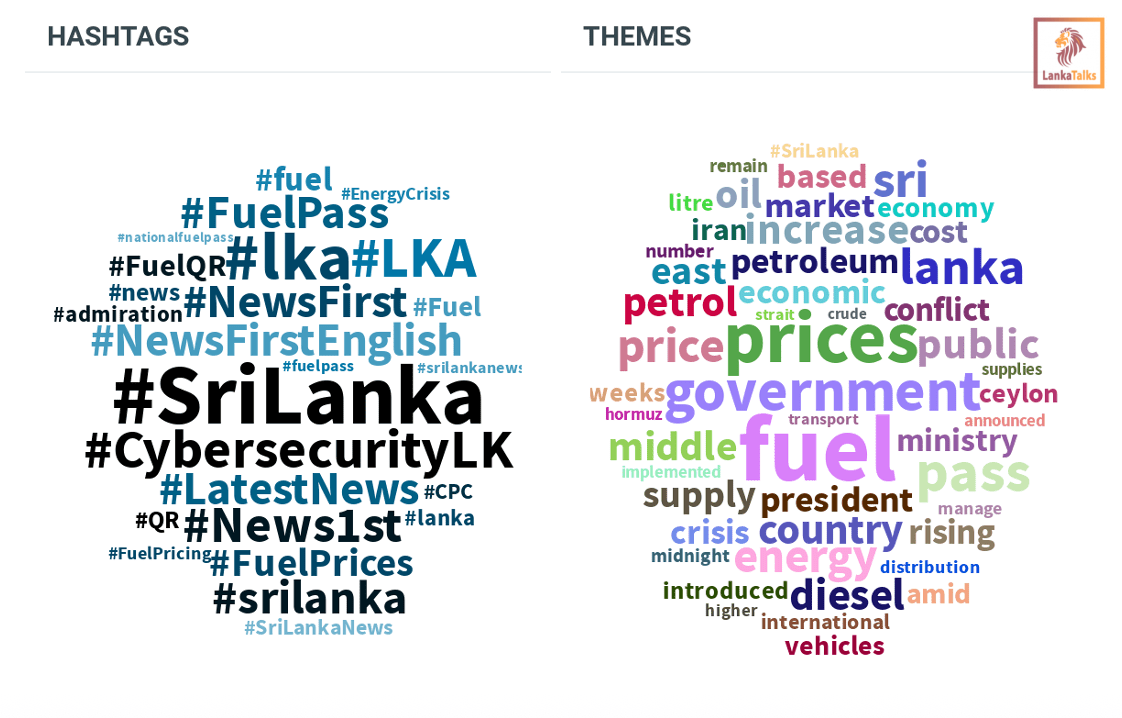
Hashtags and themes around fuel pass during March
The most-engaged single piece of content across the 30 days was a news report on the arrival of a fuel shipment carrying 35,000 metric tonnes of petroleum, which attracted 2,900 interactions. The significance of that should not be missed. In the middle of a supply anxiety, the confirmation that a ship had docked and unloading had begun was the most widely shared story of the month. People were not simply looking for someone to blame. They were looking for reassurance.
Practical updates on quota rules and how to register for the system also performed strongly, confirming that the public appetite for clear, useful information was enormous throughout. One post explaining how to retrieve previously registered QR codes after a software update spread quickly, suggesting that people were actively trying to make the system work for them even when it was letting them down.
Content reporting positive public reaction to the Fuel Pass found its audience too. Two posts in mid-March describing optimism about controlled distribution together attracted over 1,300 interactions. The conversation was not uniform in its frustration. There were people who welcomed the idea of structured rationing, who believed in fair distribution even as they struggled with the execution. And at least one ordinary citizen posted that they had filled up using the QR and number plate system in under 20 minutes, with no queue at all. That post was shared widely too.
The highest-performing post from any political source was a message from the Energy Minister crediting the technical teams who built the QR system by name, acknowledging their work publicly and without prompting. It generated 1,100 engagements. The lesson in that number is simple: recognition travels. When public figures acknowledge effort and speak plainly, people respond. The data bears that out consistently.
The Bigger Picture
Step back from the individual data points and a familiar national story comes into focus. A small, open economy absorbing a global shock, trying to manage the consequences through a rapidly deployed digital system, and discovering in real time the gap between a policy that works on paper and one that works for everyone. Sri Lanka has been here before. What is different now is the visibility.
The vehicle ownership reality of this country was not fully accounted for in the QR system design. A large proportion of Sri Lankan vehicle owners drive second-hand cars and three-wheelers with complex registration histories. When the system excluded them, they did not disappear quietly. They went online, shared their experiences, and found that thousands of others were in the same situation. The scale of that shared frustration is now on record.
The cybersecurity dimension deserves attention beyond this specific incident. Fraudulent Fuel Pass websites appeared within days of the system launching. Fake QR codes were being generated. Phishing warnings spread through social channels faster than official guidance did. That pattern speaks to a broader challenge facing digital government services in Sri Lanka: the infrastructure moves quickly, but the public protection around it sometimes does not keep pace.
There was also something quieter and more hopeful sitting in the data. Reporting on Sri Lanka's emerging renewable energy framework attracted real engagement during a month otherwise consumed by petrol queues and price revisions. It is a reminder that people have not stopped thinking about longer-term solutions. They are simply also dealing with the pressures of right now.
Why This Matters Beyond the Moment
Here is what a tool like Talkwalker makes possible. When 853 people generate 64,000 interactions around a single public issue in 30 days, that is not background noise. That is a signal. The difference between organisations that pick it up and those that miss it is increasingly the difference between getting ahead of a situation and being caught out by one.
For institutions, the value is immediate. Each of the three conversation spikes in this period was traceable to a specific, dateable event. A government ministry, a regulator, or a corporate tracking public sentiment in real time would have seen each wave forming before it peaked. That is the difference between reactive communication and the kind that actually shapes a situation.
For businesses, the relevance is equally direct. Energy companies, banks, transport operators, logistics firms, retailers, and any organisation whose customers feel the weight of fuel price rises should be paying close attention to what the public is saying. The Fuel Pass conversation was at its core a conversation about affordability, reliability, and trust. Those themes do not stay confined to one sector. They move through the whole economy.
Public conversation, properly tracked, is one of the most honest things available to a decision maker. It has no spin. It has no agenda. It is what people actually think, said openly, in their own words. Understanding it is not a luxury anymore. It is rapidly becoming a basic requirement.
Sri Lanka Is Always Talking. The Question Is Who Is Listening.
The National Fuel Pass conversation of March 2026 is a case study in how public discourse works in Sri Lanka today. The 853 voices who contributed to it were not passive or uninformed. They understood quota figures and pricing formulas. They tracked shipment arrivals. They asked who built the system and whether those people could be held to account. They connected local hardship to global conflict. They asked hard questions and they shared them widely.
One of the more striking moments in the data came from an overseas comparison someone shared: a story about a government in another country that raised fuel prices and watched public anger escalate when they brought in a celebrity to defend the decision. The post spread because it resonated. Sri Lankans recognised the pattern. They have seen what happens when institutions manage messaging instead of managing reality.
The 29 per cent negative sentiment in this dataset is not simply a problem to be managed. It is information. It tells you exactly where trust is under strain, which groups feel the system has left them behind, and which promises are not being believed. No opinion poll, no press conference, no advisory report delivers that level of insight at this speed.
Sixty-four thousand interactions happened across social media, news platforms, and digital channels during this period. That conversation ran in parallel with every official announcement and every ministerial statement. It had its own timeline, its own logic, and its own conclusions. Sri Lanka was talking. It almost always is. The only real question is whether the people who most need to hear it are actually listening.