


 Breaking News
 A.R.B.J Rajapaksha
 A.R.B.J Rajapaksha
 Apr 20 2026
 1069
1069Anuradhapura South prospered following the Mahaweli water transfer program launched in 1976 under the Mahaweli Development Plan which was approved in 1968.
This program was to ensure reliable water supply for agriculture, domestic use and commercial activities thereby transforming livelihoods of what is now known as ‘Wet Anuradhapura’.
In contrast, areas North of Anuradhapura referred to as ‘Dry Anuradhapura’ continue to face severe water scarcity despite being within five major river basins such as Malwathu Oya, Parangi Aru and Pali Aru Kanagarayan Aru, Ma Oya and Yan Oya,.
When the Government sanctioned the Mahaweli Development plan in 1968, it committed to transferring the Mahaweli surplus water to the Northern Dry Zone to uplift farming communities. Although the Mahaweli Development project began in 1970 full-scale implementation was delayed for over five decades due to financial constraints, environmental concerns and nearly 30 years of civil conflict and objections from some professional groups.
In 2015, the Government launched the North Central Province Canal Project (NCPCP) and North Western Province Canal Project (NWPCP) supported by the Asian Development Bank (ADB).
However, the economic crisis in 2022, 2023 imposed severe financial constraints further delaying the completion of NCP Canal – Stage One and the construction works of NWPCP.
The present Government has reaffirmed that water is a national resource which must be shared in unity and equitably distributed among all regions of the country.
Using the Mahaweli surplus water combined with in-basin water resource development, possible trans-basin diversion from the basin to the Mahaweli basin and groundwater utilisation is essential to reduce poverty and stimulate development in the Northern Dry Zone.
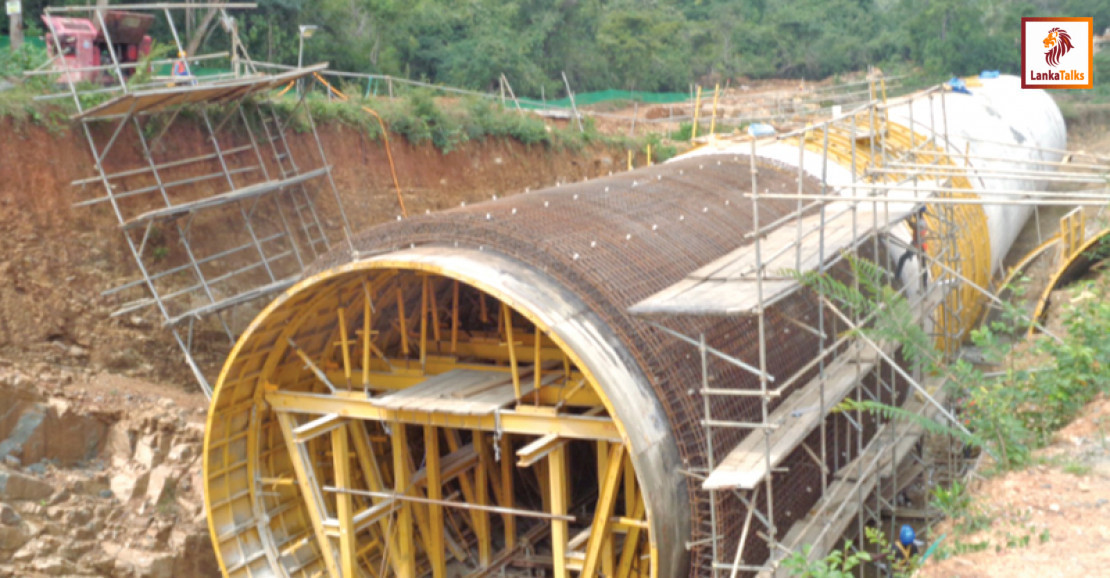
At present, mainly due to financial limitations, priority is given to complete NCP Canal stage one up to Yakalla along with remaining work of the 28 km long tunnel including water transfer to Mahakanadarawa reservoir in Anuradhapura under the ongoing Mahaweli Water Security Investment Program (MWSIP) stage 2 project.
In-basin reservoir development
The key components include the development of in-basin reservoirs in the Malwathu Oya, Parangi Aru, Pali Aru, Kanagarayan Aru and Kivul Aru Oya basins, construction of NCP Canal Stage 2 from Yakalla to Chemmaadukulam with branch canal systems (350 km), implementation of planned, Janaranjana pumping project in the lower Mahaweli river, completion of the remaining works of NWPCP, including Bowatenna tunnel-2 and Mahakithula, Mahakirula storage reservoirs in the upper Mi Oya basin, introduction of export-oriented commercial agriculture covering 5,000 hectares and environmental management including habitat enrichment and mitigation of human-elephant conflict with the setting up of the NCP Forest Corridor linking Huruluwewa and Madu forest reserve.
At present, the remaining works of NCP Canal Stage One (Moragahakanda – Yakalla 65.5 km) are being implemented under NWSIP – Stage 2 project with US$ 200 million funding from the ADB.
Around US$ 300 million in additional funding is needed to complete this stage and enable water supply to the Northern parts of Anuradhapura, including the Mahakanadarawa Tank to fully activate the Anuradhapura North drinking water project, benefitting a population of around 150,000.
Some professionals in the water resources development sector said the ongoing North Central Province Canal (NCP Canal) Project is a ‘white elephant’ burdening the economy due to the high cost of construction, doubts on water availability and limited direct and indirect benefits on completion of the project as previously planned.
The NCP Canal evolved as a water diversion infrastructure to benefit the Northern Dry Zone. During the latter part of the 1950s, the Irrigation Department (ID) carried out systematic restoration work of all ancient major irrigation projects in the Anuradhpura and Polonnaruwa districts in the North Central Province (NCP). However, they found that farming communities settled in these schemes faced hardships due to a shortage of water during the dry seasons.
Solution to water scarcity
The Irrigation Department carried out a feasibility study in the latter part of the 1950s with the United States Operation Mission of Sri Lanka to find a solution to this water scarcity problem.
They realised that the only solution was to divert excess water from the hill country in the Mahaweli river basin near Kandy to the Northern Dry Zone through a canal named as the NCP Canal. This was the first master plan of the 1961 Mahaweli Development Project.
The priority of the Government in the latter part of the 1960s was to make Sri Lanka self-sufficient in rice and to uplift the living standards of the poor farming community in the NCP, Northern Province (NP) and the Eastern Province (EP).
Taking into consideration the vast quantity of water flowing unused into the sea (close to 8,000 million cubic metres) through the Mahaweli river, the Government expanded the 1961 master plan with technical assistance from the United Nations Development Project (UNDP) to cover the entire Mahaweli River basin combined with adjacent river basins such as Maduru Oya basin.
The Government approved this plan in 1968 and implemented it in 1970. This plan includes the development of 13 large irrigation systems consisting of 365,000 ha of land with 460 MW of Hydro power generation.
The Government considered this as a high priority project and commenced its implementation in 1970 with the Polgolla-Bowatenna diversion complex to divert part of Mahaweli water mainly to the Southern parts of the NCP. The work was completed in 1976 with the diversion of the Mahaweli water to Kalawewa and Anuradhapura city tanks and Polonnaruwa tanks system under the Elahera anicut and the Angamedilla anicut.
In 1977, the Government modified the implementation strategy as ‘Accelerated Mahaweli Development Program’ (AMDP) to get the maximum benefits from hydro power generation and also to expand the Mahaweli agricultural benefit areas to Systems B and C downstream of Minipe anicut. Due to political and pressure from a group of professionals, the NCP Canal, the largest agriculture component included in the 1968 plan (Systems I to M) was dropped from the AMDP.
The subsequent 30 years of civil disturbances in the border areas of NCP and EP further delayed the implementation of the NCP Canal Project. The Government in the latter part of 2010 launched the construction work of the left out strategic Moragahakanda reservoir and completed it in 2018. In 2025, Moragahakanda was linked with the Kalu Ganga reservoir constructed in 2019 through a link tunnel.
Last phase
Based on a request by the Government in 2014, the ADB carried out a Project Preparatory Technical Assistance study to implement the last phase of the 1968 Mahaweli Master Plan. The implementation of this plan commenced in the latter part of 2015 with funding from the ADB incorporating Moragahakanda and Kalu Ganga reservoirs. This final phase was named as Mahaweli Water Security Investment Program (MWSIP).
The MWSIP encountered several challenges such as cost increase, delays in implementation and the financial crisis in 2021-2022 which caused suspension of ADB funding for the balance contract packages.
The ADB with co financers is now in the process of finalisation of the loan requirement to complete the remaining work – the NCP Canal from Moragahakanda to Yakalla 65.5 km in length as MWSIP-Stage 2.
In 2015, it was planned to complete the NCP Canal Phase 1 (Moraghkanda to Yakila – 65.5 km) and NCP canal Phase 2 (Yaklla to Chemmadukulum – 85 km North of Vauniya) concurrently.
Due to financial constraints, it is now planned to implement the NCP Canal project in stages by completing NCP Canal Stage 1 to Yakalla and extend the NCP canal in stages as per funding availability. The area beyond Yakalla is covered by five major river basins, Malwathu Oya, Parangi Aru – Pali Aru, Kanagarayan Aru, Ma Oya and Yan Oya. All these river basins originate in the Dry Zone hill areas and dry up soon after the monsoon rains. Along with transfer of water it is necessary to develop all in-basin water resource projects such as the Lower Malwathu Oya, Upper and Lower Parngi Aru, Lower Pali Aru, Upper Kanagarayan Aru and Kivul Oya reservoirs as originally planned in the 1968 Mahaweli Development Plan.
Now forgotten
The surrounding bio diversity in the Anuradhapura city and dry Kala Oya basin that changed with Mahaweli diversion in 1976 with the dusty Anuradhapuara city converting to a green city and water-short Rajangana reservoir changing into a water rich reservoir and Kala Oya becoming a perennial river and also providing irrigation water for two seasons is now forgotten.
A similar change could be expected with NCP canal which will benefit about 500,000 ha. With the diversion of water to this region the environment will change drastically in the future with flow in the five major rivers to change as perennial rivers and the entire area designated as a commercial agriculture development zone in Sri Lanka.
The area could also be developed as a major tourism hub similar to the Habarana tourism development zone with the diversion of water to this area through the Huruluwewa Feeder Canal and the diversion of water to the Mineriya and Kandalama tanks.
After the NCP Canal project is completed the Government will be able to use an additional 1,000 MCM (Million Cubic Metres) of water flowing into the sea. The NCP Canal Project will complete the most complex and needy water resources development project and convert the Northern Dry Zone area to the export-oriented fruit producing zone of Sri Lanka strengthening rural livelihood, creating jobs for youth and building climate resilience in the agri food sector.
Source - Sunday Observer