



 Breaking News
 LankaTalks
 LankaTalks
 Apr 27 2026
 800
800- Real-world charging data shows that EVs contribute far less to peak electricity demand than commonly assumed
- Even under higher simultaneous charging scenarios, EV-related demand remains within manageable levels
- With the right systems in place, EVs can support grid stability by shifting demand to off-peak periods and absorbing excess renewable energy
Recent discussions around electric vehicles (EVs) and their impact on Sri Lanka’s electricity grid have gained traction, particularly amid broader global energy uncertainty. Concerns around grid stability are both valid and important as the country navigates evolving energy conditions, making it essential to examine how emerging technologies interact with existing infrastructure.
Among the concerns raised is the suggestion that EV charging has contributed significantly to peak electricity demand, between 6:00 p.m. and 10:00 p.m., with figures of up to 300 MW being cited. While such estimates highlight the importance of grid stability, they also underscore the need to examine how these figures are derived, and whether they reflect real-world usage patterns.
Perception vs Reality: Understanding the numbers
It is likely that such estimates are based on a theoretical scenario where the total number of EVs is multiplied by the maximum charging capacity of each vehicle, assuming that all are charging simultaneously. In practice, this is rarely the case.
Data from Volt Charge’s networks indicates that only a portion of EV users charge at any given time, with fast charger utilisation typically ranging between 10–20%. While Volt Charge represents a growing share of Sri Lanka’s charging infrastructure, these patterns are broadly consistent with global EV usage trends. In addition, a significant share of the EV fleet consists of lower-powered vehicles, such as two- and three-wheelers, which have a considerably lower impact on overall demand.
Registration data from JB Securities also points to this broader mix within the vehicle base. Two-wheelers account for the largest share of EV registrations in Sri Lanka by a significant margin, while EV cars and SUVs represent a comparatively smaller proportion. As these segments have substantially lower charging requirements, overall electricity demand from EVs is more distributed and less intensive than often assumed.
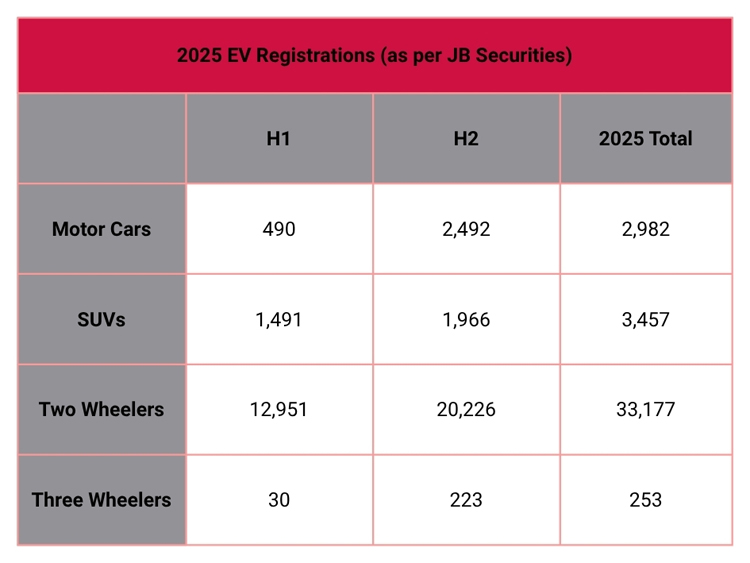
Taken together, this suggests a clear gap between perceived and actual grid impact, and highlights the importance of grounding public discourse in observed behaviour.
Understanding charging behaviour through data
Charging data provides further insight into how EVs interact with the grid. When scaled to reflect the full national EV fleet, Volt Charge’s network data shows a 72-hour interpolated peak of just 3.13 MW.
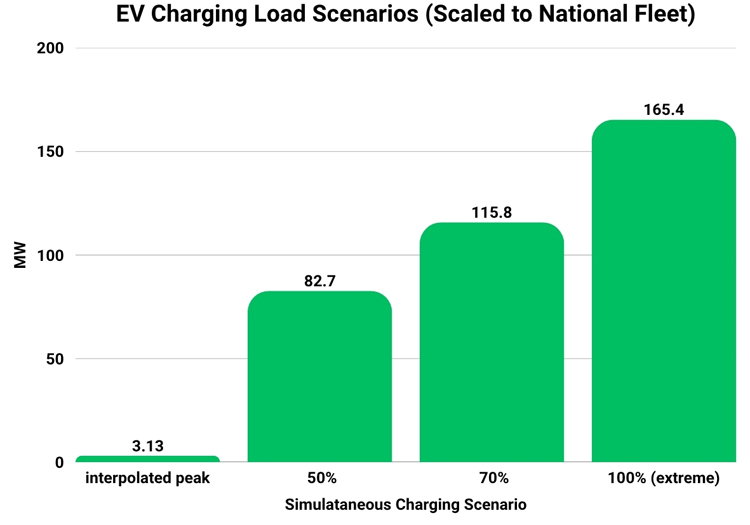
*The peak demand figure is derived by mapping all recorded charging sessions onto a continuous timeline and identifying the moment of highest simultaneous draw. This observed peak is then scaled by VoltCharge's estimated market share to produce a national estimate across all public and private charging.
Even when modelling higher levels of simultaneous charging, the overall impact remains relatively contained. At 50% and 70% simultaneous charging, estimated demand rises to approximately 80–115 MW, while an extreme scenario in which every EV in the country charges at full capacity simultaneously would reach around 165 MW.
While such scenarios are unlikely in practice, the comparison highlights the gap between perception and actual grid impact. In reality, EV charging demand remains well within manageable bounds, reinforcing the importance of grounding discussions around grid stability in observed data.
Shifting grid strain to stability
Viewed through this lens, EVs are not simply an additional load on the system, but can in fact contribute to a more balanced and efficient energy network. Rather than contributing to grid strain, EVs have the potential to support grid stability.
During periods of high solar generation, the grid can produce more energy than is immediately required. This creates a need to absorb excess supply efficiently. EVs, as flexible loads, can be aligned with these periods, helping to utilise available energy that might otherwise go underused.
This is where smart charging becomes increasingly relevant. With the right systems and targeted incentives in place, EV charging can be shifted to off-peak night-time hours or aligned with daytime solar generation. Many EVs already support scheduled or time-based charging, allowing users to programme when their vehicles draw power, rather than charging immediately upon being plugged in.
Recent revisions to electricity tariffs, including the introduction of time-of-use structures for EV charging, are a step in this direction. By creating a clearer price signal, such measures can encourage consumers to adopt more optimised charging behaviours, aligning individual usage with broader grid requirements. The continued expansion of charging infrastructure into office spaces and other daytime locations, alongside clearer peak and off-peak tariff differentials, will further support this shift by making it easier and more practical for users to charge during optimal periods.
The fuel dependency question
While it is true that a portion of Sri Lanka’s electricity is still generated using fossil fuels, CEB data indicates that this accounts for around 58% of total generation. However, this comparison does not fully account for differences in energy efficiency.
Electric vehicles typically convert about 60-90% of electrical energy into motion at the motor level, compared to approximately 15–30% efficiency in a typical internal combustion engine vehicle. Even when accounting for generation losses at the power plant level, EVs make more efficient use of the energy produced. As Sri Lanka continues to expand its renewable energy capacity, this efficiency advantage is expected to become even more pronounced.
Towards a more balanced energy system
As EV adoption grows, the conversation is gradually shifting from whether the grid can accommodate these vehicles, to how their integration can be optimised. Current data suggests that EV charging is already largely aligned with grid needs, both by avoiding peak demand periods and by supporting the utilisation of available energy during the day.
Data shared by charging providers such as Volt Charge is also contributing to a broader understanding of these patterns, with ongoing efforts to support more coordinated, system-level planning across stakeholders.
Ultimately, a data-led approach, supported by the right policy frameworks, infrastructure development, and consumer awareness, will be key to ensuring that EV adoption strengthens Sri Lanka’s energy resilience while contributing to a more efficient and sustainable energy future.
Source: Adaderana