


 Breaking News
 Sheron
 Sheron
 Apr 16 2026
 637
637Asia Pacific governments taking measures to contain the impact of the West Asia energy shock, may reduce immediate inflation and social risks, but shift pressure onto sovereign balance sheets and state-linked entities, Fitch Ratings says.
“Fiscal support of various forms is absorbing a large part of the shock in several markets,” the global ratings agency pointed out.
Sri Lanka announced a 100 billion rupee relief package.
“These measures can moderate inflation and support demand, but prolonged use risks weakening fiscal flexibility that has already fallen significantly since the Covid-19 shock.”
Price controls, which limit the immediate pass-through of global energy prices, distort market signals and can defer rather than remove credit stress, Fitch said, with state-linked entities increasingly carrying part of the burden.
Administrative curbs and supply management that reduce immediate shortages also lead to rising policy intervention if the shock persists, it said highlighting that Sri Lanka had tightened fuel rationing.
The full statement is reproduced below:
APAC Countries Cap Energy Shock, Shifting Costs to Public Sector
Fitch Ratings-Singapore/Hong Kong: APAC governments are taking diverse measures to contain the near-term credit impact of the Middle East energy shock, including through subsidies, price caps, administrative curbs and energy import diversification, Fitch Ratings says. Many of these measures reduce immediate inflation and social risks, and should cushion near-term operating conditions for many corporates and reduce the risk of abrupt demand destruction. However, they shift pressure onto sovereign balance sheets, state-linked entities and regulated energy systems, creating uneven credit consequences across sovereigns, energy companies and regulated utilities.
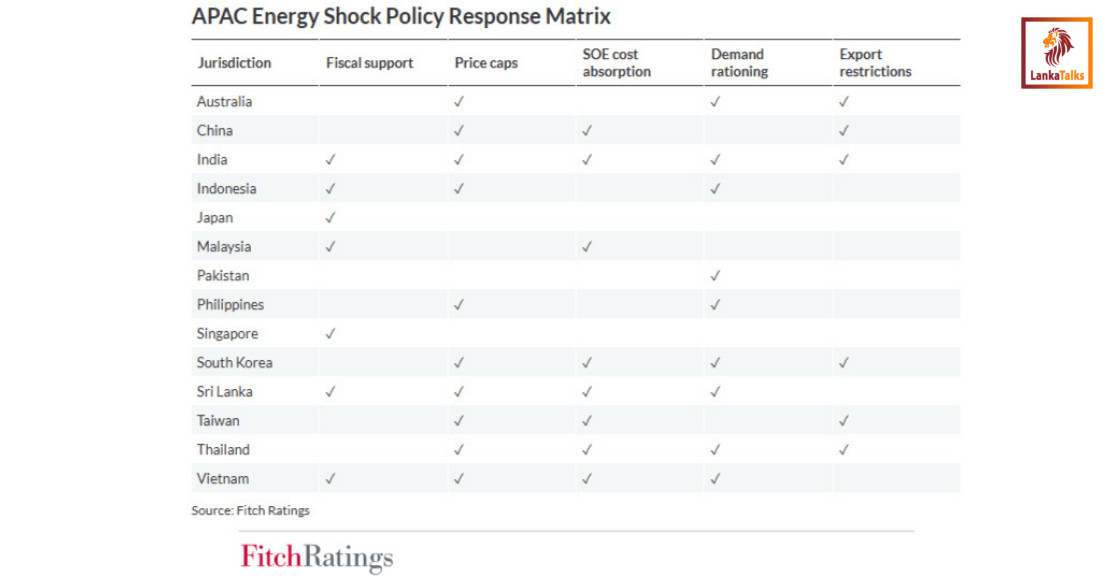
Fiscal support of various forms is absorbing a large part of the shock in several markets. Vietnam extended its fuel tax suspension until end-June and removed import tariffs until end-April. Malaysia’s monthly RON95 petrol and diesel subsidy bill rose to MYR3.2 billion from MYR700 million, while Singapore raised its corporate tax rebate to 50% from 40% and announced about SGD1 billion in reliefs. Sri Lanka announced a Rs100 billion relief package. India waived full customs duties on 40 petrochemical products and cut special additional excise duties on petrol and diesel. These measures can moderate inflation and support demand, but prolonged use risks weakening fiscal flexibility that has already fallen significantly since the Covid-19 shock.
Price controls, which limit the immediate pass-through of global energy prices, distort market signals and can defer rather than remove credit stress. Some governments, like in Pakistan, the Philippines and Thailand, have allowed movements in domestic fuel prices, while others, including Indonesia and India, have kept pump prices relatively stable. China raised gasoline and diesel prices to levels below cost increases. South Korea will keep its fuel price caps unchanged for another two weeks. Thailand ordered diesel and refinery price cuts while limiting power bill increases to 1.8%, and the Philippines suspended its electricity spot market to prevent a surge in market-linked electricity bills. These actions, while supporting near-term affordability, can weaken profitability for refiners, fuel distributors and power-sector entities if compensation is delayed or incomplete.
State-linked entities are increasingly carrying part of the burden, containing social risks but potentially weakening standalone credit profiles. Taiwan’s CPC Corporation first absorbed most of the higher fuel costs, before raising liquefied natural gas prices for the power sector by 42%. India froze its retail fuel prices while capping refinery margins at USD15/barrel after the government imposed a windfall export tax. Thailand’s Oil Fuel Fund has been depleted enough to seek a loan. Fitch sees the use of quasi-fiscal channels as credit-neutral only where sovereign support is timely and credible; otherwise, leverage and cash flow pressure could build at affected entities.
Administrative curbs and supply management that reduce immediate shortages also lead to rising policy intervention if the shock persists. Indonesia ruled out a subsidised fuel price hike through year-end, capped subsidised fuel sales at 50 litres per day per car, and introduced a weekly work-from-home policy for central government employees while cutting official travel and vehicle use. Sri Lanka tightened fuel rationing, Pakistan moved to a four-day work week, while Thailand prepared a fuel rationing plan. China asked major refiners to suspend exports of gasoline, diesel and jet fuel, and South Korea curbed naphtha exports. Australia is considering limits on Queensland liquefied natural gas exports.
Most APAC policymakers are prioritising social and macro stability over full price transmission. That should mitigate near-term pressures on the private sector, but the burden is migrating from consumers to public finances, regulated energy systems and state-linked issuers.
source: Economy Next