


 Breaking News
 Afrin
Afrin Afrin
Afrin Jan 07 2026
 535
535Sri Lankas healthcare system operates with little margin for disruption. Economic pressure and climate- driven emergencies that strain major infrastructure regularly test hospital operations.
In this environment, commitment to reliability cannot remain simply a communications line. It determines whether endoscopy units function or fall behind. For Biomed International, a company that has built
healthcare service capability in Sri Lanka for more than three decades, this commitment has taken practical form.
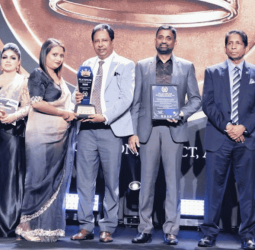
The launch of the Pentax manufacturer-certified Service Centre on 07 November 2025 reflects a Biomed-led initiative grounded in sustained technical decisions.
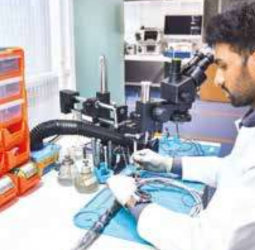
This marks Sri Lankas first principal manufacturer-certified service centre in endoscopy services. Established through the nearly three- decade-long partnership between Biomed International and Pentax Medical, the certified centre authorizes full end-to-end local repair of Pentax endoscopy systems in line with the manufacturers global standards.
Equipment that previously required overseas shipment can now be repaired locally under audit conditions. Pentax Medicals Director of Commercial Operations, Rohit Chauhan, describes the certification as the result of proven capability over many years. He notes that the centre demonstrates Biomed International’s ability to meet Pentax Medical's global service standards through disciplined local engineering.
A service capability built in stages
The partnership between Pentax Medical and Biomed International began with early public-sector adoption of Pentax endoscopy systems in Sri Lanka. One of the first major milestones came in 2002–2003, when Biomed International installed a Pentax video endoscopy system at a hospital in Badulla, an event welcomed by the local community with a Perahera procession.
An event that underscored the sense of gratitude and appreciation for the work Biomed International continues to do in healthcare services beyond centralized metropolitan cities.
As the installed base grew beyond Colombo, Biomed International made a strategic decision not to rely on overseas repairs indefinitely, and rather committing instead to developing local service capability. Biomed International established its first Pentax endoscopy repair workshop in 2007, handling approximately 30% of repairs locally.
Tooling and scope were limited, but the groundwork for in-country service was laid. From 2012 onwards, the workshop was progressively upgraded. Repair capability expanded to approximately 70- 80%, supported by improved tooling and targeted technical training that built on local skills.
This phase marked the transition from basic repair support to manufacturer-aligned service discipline. The current facility represents the final stage of that progression.
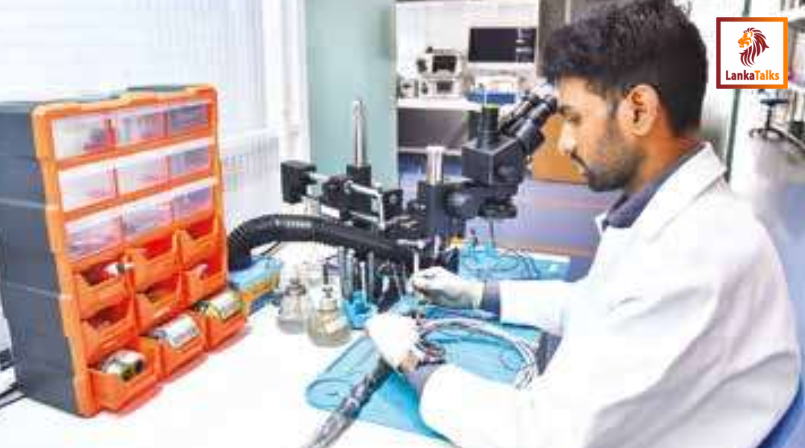
Today, the workshop operates with 100% local repair capability, meeting Pentax Medical’s global standards for environmental controls, tooling
standards, documentation, and audit compliance. Annual audits and re-certification formalize standards developed incrementally over the years. Biomed International's Director and CEO, Namal Dodangollegama, describes the certification as validation of the companys commitment to a long-term
service strategy.
He notes that sustained investment in people and processes was prioritized even when it required slower growth. The certification also positions Sri Lanka as one of only two Pentax Medical- certified service centres in the SAARC region, enabling Biomed International to support regional repairs while anchoring technical expertise locally.
Engineering discipline, delivered collectively
The service centre operates through a structured engineering model. While overseen by Mr. Jude Sweendran, General Manager, Engineering, delivery is designed to avoid individual dependency.
Engineers and technicians, including Nipuna Prabath, Dineth Perera, Shashika Dilshan, and Isuru Perera, work across defined stages of the repair process: diagnostics, image-based fault identification, documented risk assessment, component replacement, and post-repair validation.
Their commitment to quality work is highly praised by the principal manufacturer and is the prime reason behind the success story. Each step is mandatory under Pentax certification and subject to audit. Jude’s background includes years of field service across Sri Lanka, including braving the Northern regions during the civil conflict.
That experience informs a culture centred on preparedness and procedural discipline, now embedded into workflow rather than reliant on personal intervention. Taraka Wijebandara, Endoscopy Division Manager at Biomed International, points to predictability as the key outcome. “Hospitals need
certainty that failed scopes can be fully repaired locally and returned to service without long delays.
That confidence comes from having a trained team and a certified process in place,” he says. Service under operational stress The company’s service model is designed to respond quickly when disasters create urgent, high-risk
equipment failures across hospitals. Clinical services at District General Hospital Chilaw were restored within weeks following Cyclone Ditwah due to local service execution.
Two Pentax endoscopy systems were fully submerged after flooding of nearly 12 feet. Biomed International conducted on-site inspection on 03rd December 2025, removed salvageable components, and completed system
reassembly and testing by 15 December 2025.
The recovery, valued at approximately Rs. 35 million was delivered free of charge, avoiding prolonged service downtime despite wider infrastructure disruption.
Biomed International built service reliability by training and embedding engineers directly within hospital networks across the country, rather than relying only on centralized response teams.
Technicians were stationed in high-need regions to provide immediate maintenance and emergency support.
This decentralized model ensured continuity of care even when transport routes or access were
disrupted.
Why certification matters now
For patients, the certification shortens equipment downtime, allowing endoscopy units to resume
procedures sooner.
This reduces postponements caused by unavailable scopes, easing backlogs, and helping patients receive timely diagnosis and treatment, particularly in public hospitals where delays have wider consequences. For hospitals and clinicians, the certified local repairs to Pentax Medical standards restore planning certainty.
Biomedical engineers work with the trained local teams who
understand hospital constraints, keeping services running even during disruption.
Looking ahead The Pentax Medical-Certified Service Centre represents the outcome of sustained technical development. Its significance lies in institutional maturity that is committed: a service capability built in
stages, audited, and now regionally relevant.
As Sri Lanka’s healthcare system operates under constraint, this certification delivers a practical advantage. Certified repairs are now completed locally,
reducing overseas spending and retaining value within the Sri Lankan economy.
For hospitals, this means lower repair costs and uninterrupted endoscopy services when continuity matters most.
Source: TheMorning