


 Breaking News
 A.R.B.J Rajapaksha
 A.R.B.J Rajapaksha
 Apr 23 2026
 409
409There is a conversation that does not happen often enough in Sri Lankan workplaces, boardrooms, or at the family dinner table. It is not about salaries, or school fees, or the cost of the next car. It is about what happens when the salary stops.
Most professionals in their thirties and forties are managing life reasonably well, or working hard at it. They have mortgages, school fees, the occasional holiday, perhaps a small investment on the side. They know EPF exists. They probably have a passbook somewhere. What most of them have not done is think carefully about what that EPF balance will actually mean when the time comes to stop working.
It is a gap that Ceylinco Life, as Sri Lanka's life insurance market leader, has spent three decades observing, and one it believes the professional class can no longer afford to ignore.
This is not carelessness. In many ways, it is entirely rational. When you are forty, retirement is two decades away. Two decades is an abstraction, and it is difficult to feel urgency about an abstraction. The problem is that by the time it stops feeling abstract, the window for meaningful action has largely closed.
The EPF Illusion
Let us look at what EPF actually delivers. According to the EPF Annual Report 2024, total EPF benefit payments for the year amounted to approximately LKR 230 billion, including both retirement settlements and authorised pre-retirement withdrawals for housing and medical purposes permitted under the Act. These payments represent workers exiting the system at retirement or upon death, often after decades of contributions. When the retirement-specific payouts are considered against the number of members leaving the Fund, the average EPF balance available at retirement remains modest. Sri Lanka’s standard retirement age for private sector workers is 60, while average life expectancy now stands at approximately 77 to 78 years. That arithmetic alone should give pause: spread across an expected retirement period of fifteen or more years, the typical EPF settlement translates into only a few thousand rupees per month.
For context: a kilogram of rice costs more today than a full meal did a decade ago. A single private hospital consultation can run to LKR 2,000 to 4,000. A monthly prescription for a common chronic condition easily exceeds LKR 10,000. EPF, on its own, does not cover any of this with any real comfort.
And that is before inflation enters the picture, the most patient and persistent force in personal finance. Sri Lanka’s inflationary history is a reminder of how corrosively time erodes purchasing power. A monthly income that feels adequate at retirement can lose a substantial portion of its real value within a decade. The numbers are not punishing by accident. They are simply the mathematics of time and money working against anyone who is not paying attention.
The typical EPF settlement, spread across fifteen or more years of retirement, amounts to only a few thousand rupees a month. At today’s cost of living, that is not a retirement income. It is a problem.
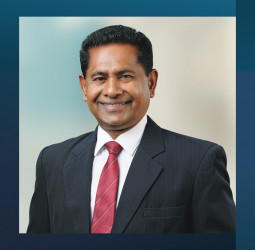
"EPF was never designed to be a complete retirement solution. It is a foundation, and a necessary one, but for the professional class in particular, treating it as the whole answer is a decision that will be felt very painfully in the final decades of life," says Ranga Abeynayake, Director/ Deputy CEO.
Who Is Most at Risk
It would be a mistake to assume that retirement vulnerability is a problem only for low-income workers. The professional class, middle and upper-middle income earners with stable jobs and reasonable salaries, carries its own version of this risk. In some ways, a more insidious one.
Professionals tend to carry higher lifestyle costs. Their housing is more expensive. Their children attend better-resourced schools. They eat out more, travel more, and spend more on healthcare. When retirement comes, the monthly income gap they need to fill is rarely LKR 50,000. It is more often LKR 150,000 to 200,000 or above, depending on the life they have built.
Yet retirement savings rarely scale in proportion to that income. EPF contributions are capped by salary bands. Many private sector professionals, particularly those who have moved between employers, have fragmented EPF records with inconsistent balances. Business owners and the self-employed may have no EPF at all. And very few, across any of these categories, have sat down and calculated their actual monthly requirement at retirement, adjusted for inflation, healthcare costs, and the possibility of a partner who may outlive them by a decade.
"The professionals we are most concerned about are not struggling today. They have good salaries, reasonable assets, and every intention of sorting out retirement eventually. That word, eventually, is where the problem lives," says Abeynayake.
The Sandwich Generation Problem
There is one group that deserves particular attention: what demographers refer to as the sandwich generation. These are people, typically in their forties, who are simultaneously supporting their children through education and their ageing parents through retirement or illness. Financially, they are being pressed from both sides, and their own retirement savings are invariably the first thing to be deprioritised.
Sri Lanka's demographic trajectory makes this harder. By 2042, one in four Sri Lankans will be elderly. That shift places mounting pressure on the working-age population. Many of today's forty-year-olds will, in practice, be funding two retirements, their parents' and eventually their own, while simultaneously navigating the most expensive phase of raising children. Without a plan, that combination is a financial storm.
"We are seeing a generation that is financially stretched in every direction at once. Supporting parents, funding children's education, managing mortgages, and somehow expected to build a retirement nest egg at the same time. Without a structured plan, something has to give, and it is almost always the retirement savings," says Abeynayake.
What a Plan Actually Looks Like
The good news is that this is solvable. Not easily, and not without discipline, but solvable. The single most important factor is time, which means starting earlier than feels necessary. A sound retirement plan accounts for three things: the monthly income you will need, the inflation that will steadily erode it, and the gap between what you have already accumulated and what you will actually require. Most people, when they run this calculation honestly for the first time, are both surprised and sobered. Most also find that the gap is bridgeable if they begin now.
"A retirement plan does not need to be complicated. It needs to be honest. Honest about the income you will need, honest about what inflation will do to it, and honest about the gap between where you are today and where you need to be. Most people who do that calculation for the first time find the gap is bridgeable. But only if they start," says Abeynayake.
Structured retirement products, designed to deliver regular income through retirement rather than simply returning a lump sum at the end, are a central part of that solution. They are not a luxury reserved for the wealthy. They belong in the same category of financial decisions as health insurance or a child's education plan. The real question is not whether you can afford to plan for retirement. It is whether you can afford not to.
The Conversation That Is Long Overdue
Sri Lanka is at a demographic inflection point. The population is ageing faster than the systems designed to support older citizens are evolving. This is not a challenge that government policy alone will resolve. It requires individual action, and the earlier that action is taken, the more manageable the outcome.
The retirement conversation in this country has been too quiet for too long. It has been left to HR departments, occasional newspaper columns, and the rare financial adviser who raises it unprompted. It deserves far more. It deserves the same urgency we bring to career decisions, property investments, and our children's futures. Because retirement comes for everyone. The only question is whether you will be ready.
Ceylinco Life has been Sri Lanka's life insurance market leader for twenty-two consecutive years. Its Life Fund has crossed LKR 200 billion, reaching LKR 201.81 billion at end 2025, and the company paid LKR 31.07 billion in claims and benefits to policyholders that year. The Retirement Ready campaign draws on three decades of insight into how Sri Lankans save, spend, and plan, and what happens when they do not.
"Twenty-two years as market leader comes with a responsibility that goes beyond selling policies. We have watched this retirement gap widen for three decades. Retirement Ready is our way of saying, clearly and publicly, that this conversation cannot be left to chance any longer," Abeynayake concludes.