


 Breaking News
 A.R.B.J Rajapaksha
 A.R.B.J Rajapaksha
 Mar 12 2026
 929
929~An evening at DFCC Bank turns attention to the fragile balance of Sri Lanka’s wilderness~
The Sri Lankan leopard rarely announces itself. It moves through forests quietly, a shadow between trees, a flicker of rosettes in the undergrowth, a presence felt more often than seen. Yet the animal holds together far more than its own survival. As the island’s apex predator, the leopard regulates prey populations and helps maintain the balance of ecosystems that support forests, water systems, biodiversity and ultimately human life. When that predator begins to disappear, the silence ripples outward.
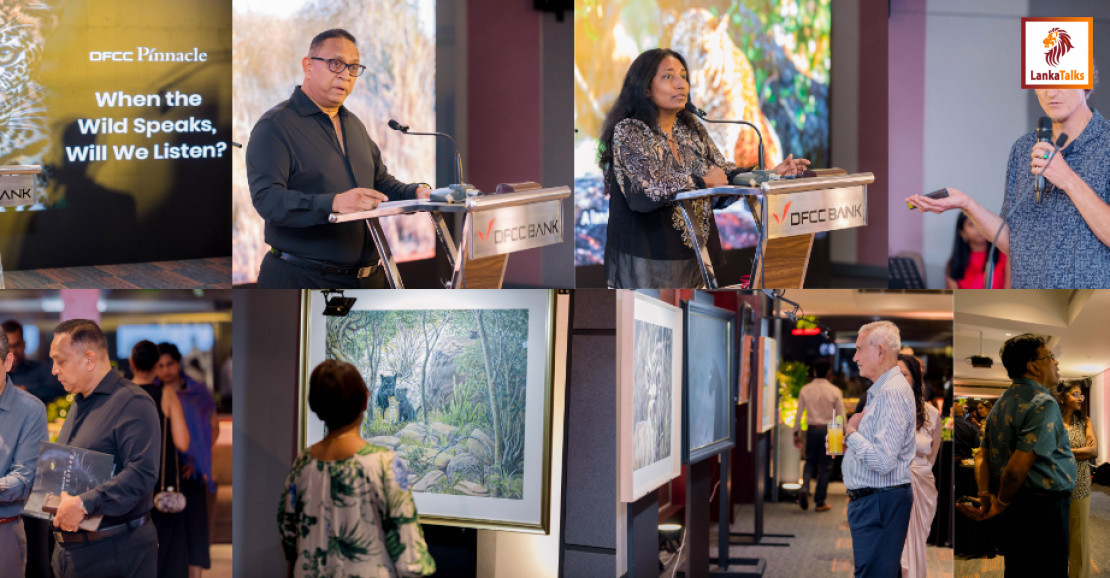
This reality set the stage for a special evening at DFCC Bank PLC, when the Bank opened its Head Office for a conversation titled “When the Wild Speaks, Will We Listen?” — focusing on Sri Lanka’s elusive leopard and the fragile ecosystems that sustain it.
The gathering brought together conservationists, wildlife storytellers, scientists and guests for a discussion centred on a simple but profound question. What does it mean to protect the wild in a country where human and natural worlds increasingly overlap?
For DFCC Bank, the initiative forms part of a broader effort to raise awareness about biodiversity and the ecosystems that underpin national resilience. The Bank has partnered with the Wilderness and Wildlife Conservation Trust (WWCT) to support science-based conservation efforts focused on safeguarding the Sri Lankan leopard and the landscapes it inhabits. The principle behind that effort is straightforward. Protect the leopard and you protect everything around it.
The Sri Lankan leopard, Panthera pardus kotiya, is the island’s only large terrestrial predator. Its presence signals a functioning ecosystem, one where prey populations remain balanced and forests remain intact. When those systems begin to deteriorate, the leopard is often among the first to feel the impact.
Across Sri Lanka, conservationists point to growing pressures. Forest corridors are becoming fragmented. Snares set for bushmeat trap leopards unintentionally. Expanding human settlements push wildlife closer to conflict zones.
These pressures do not affect wildlife alone. They weaken environmental systems that support agriculture, water security and climate resilience.Where the leopard survives, the ecosystem survives with it.
At the centre of the evening’s discussion was Senaka Kotagama, whose life has bridged two seemingly distant worlds. On one hand lies the disciplined precision of Sri Lanka’s tea industry, where Kotagama is widely recognised as a tea taster and exporter with more than four decades of experience. On the other lies the unpredictable terrain of wildlife exploration.
Beyond boardrooms and plantations, Kotagama has spent years travelling across remote landscapes documenting wildlife.
His book, The World of the Black Leopard, captures one of the rarest sights in Sri Lanka’s wilderness. The melanistic leopard, with its dark coat and almost spectral appearance in the forest, remains one of the island’s most elusive creatures.
The photographs he shared during the evening did not present wildlife as spectacle. Instead, they revealed patience. Weeks can pass without a sighting, Kotagama explained. The forest remains still. Then, for a brief moment, the leopard appears. Silent, watchful, and gone again. Those fleeting encounters carry meaning far beyond photography. They are proof that the ecosystem still holds.
Joining the discussion were conservationists Anjali Watson and Dr. Andrew Kittle, whose work has helped shape global understanding of the Sri Lankan leopard.
As co-founders of the Wilderness and Wildlife Conservation Trust (WWCT), they have spent decades studying the species in landscapes ranging from national parks to human-dominated environments. Their research contributes directly to international conservation assessments and strategies for protecting the species. One of their central findings is that leopard conservation cannot succeed through protection alone. It requires coexistence.
Many leopard deaths occur not through deliberate hunting but through snares set for other animals or conflicts arising from livestock losses. Solutions therefore depend as much on community engagement as they do on scientific research. Conservation, in other words, is not only about wildlife. It is about people.
As the evening drew to a close, guests moved through an exhibition of Kotagama’s wildlife photographs displayed around the venue. Each image captured a rare encounter. A leopard emerging from shadow. A moment of stillness in dense forest. A predator that continues to move unseen through landscapes most people rarely experience.
Yet the photographs carried another message as well. Rarity can be beautiful. It can also be a warning. Across the world, apex predators have often disappeared quietly, their absence noticed only when ecosystems begin to unravel.
Sri Lanka’s leopard still roams its forests. The question raised during the evening was not whether the animal will speak. It was whether we are willing to listen.