


 Breaking News
 Puvanya
 Puvanya
 Oct 20 2026
 23
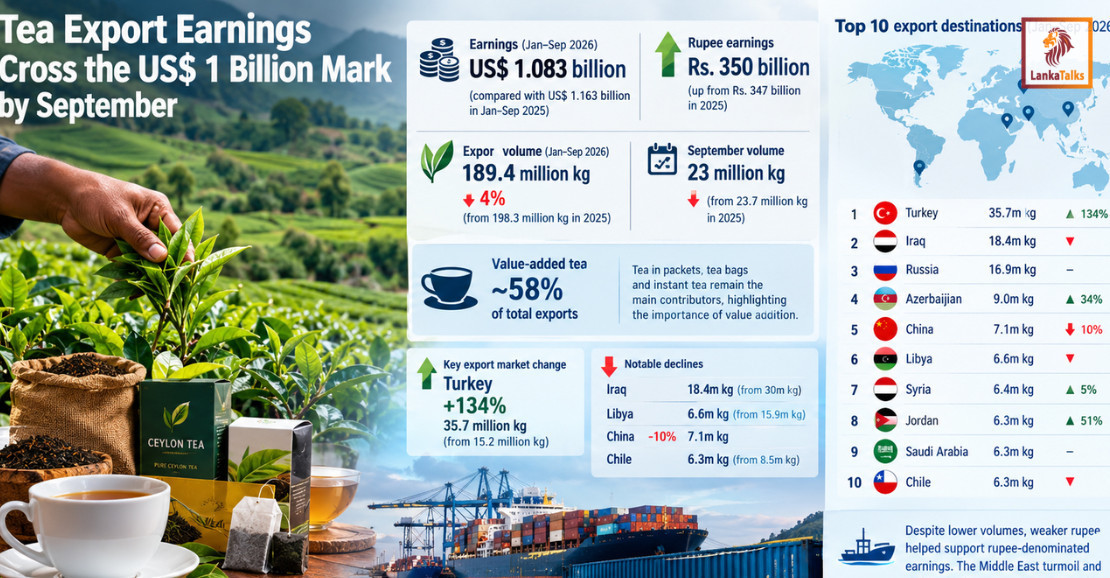
Customs data analysed by Siyaka Research indicates that Sri Lanka’s tea export earnings reached approximately US$ 1.083 billion during the January–September 2026 period, compared with US$ 1.163 billion earned during the corresponding period of the previous year.
Despite September export volumes declining to 23 million kg from 23.7 million kg a year earlier, cumulative earnings in Sri Lankan Rupees increased to Rs. 350 billion from Rs. 347 billion. This improvement was largely attributable to the depreciation of the Rupee against the US dollar.
Total tea export volumes for the nine-month period amounted to 189.4 million kg, down 4% from 198.3 million kg recorded in 2025. The decline in export volumes was less pronounced than the depreciation of the rupee over the period, helping to support rupee-denominated export earnings despite lower USD earnings.
Value-added tea exports continued to account for approximately 58% of total exports. Tea in packets, tea bags and instant tea remained the principal contributors to this segment, underscoring the continued importance of value addition to Sri Lanka’s tea export trade.
Against the backdrop of ongoing turmoil in the Middle East, export flows to and through Turkey recorded a significant increase of 134%, rising to 35.7 million kg from 15.2 million kg a year earlier.
Iraq, traditionally one of Sri Lanka’s key tea destinations, recorded a sharp decline in imports to 18.4 million kg from 30 million kg in the corresponding period of 2025. Russia maintained relatively steady volumes at 16.9 million kg, while exports to Azerbaijan increased by 34% to 9 million kg.
Shipments to China declined by 10% year-on-year to 7.1 million kg. Libya also recorded a substantial reduction, with volumes falling from 15.9 million kg to 6.6 million kg, reflecting changes in shipment patterns and the movement of goods through alternative routes.
Exports to Syria improved by 5% to 6.4 million kg, while shipments to Jordan increased by 51% to 6.3 million kg, indicating a shift in trade flows amid the regional disruptions. Saudi Arabia continued to perform steadily, with Sri Lanka shipping 6.3 million kg during the period, broadly in line with the previous year.
Chile rounded off the top ten destinations, with exports declining sharply to 6.3 million kg from 8.5 million kg a year earlier. Chile’s total tea imports reached a five-year high of 21.8 million kg in 2025. However, the latest figures suggest that the market may be relinquishing some of those gains in 2026.