


 Breaking News
 A.R.B.J Rajapaksha
 A.R.B.J Rajapaksha
 Mar 16 2026
 970
970Virtual Reality (VR) creates fully digital worlds; Augmented Reality (AR) overlays digital elements onto real places; Mixed Reality (MR) blends into an interactive experience. Together, they can transform how tourists explore Sri Lanka’s past, present and future.
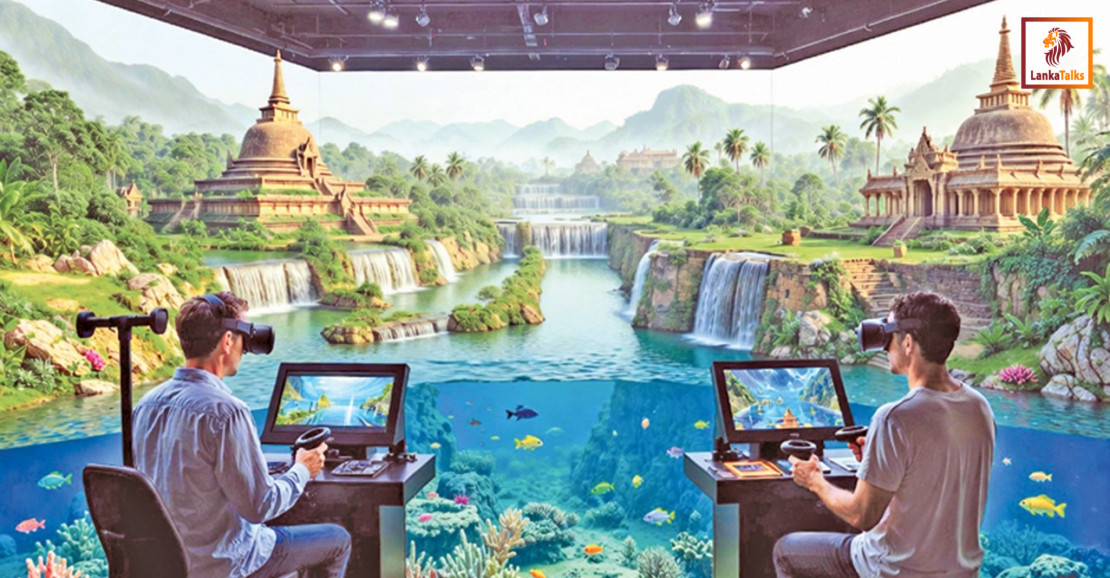
Virtual Reality, Augmented Reality and Mixed Reality—often spoken of as futuristic concepts—are now everyday tools in global tourism. VR places a visitor inside a completely digital environment, allowing them to walk through a recreated ancient kingdom or dive into an underwater world without leaving the room.
AR enhances realworld locations by overlaying digital information, such as animations, historical reconstructions or interactive guides, onto what the visitor sees through a phone or smart glasses. MR goes a step further by allowing the visitor to interact with digital objects as if they were physically present. In tourism, these technologies have already reshaped how travelers learn, explore and emotionally connect with destinations.
Countries across Asia and the developed world have embraced these tools with remarkable success. India uses AR at the Taj Mahal and Red Fort to show visitors how the monuments looked centuries ago. China has created VR theme parks and digital heritage corridors that allow travelers to experience dynasties long gone.
Malaysia uses AR in rainforest parks to identify flora and fauna instantly, while South Korea has built entire VR zones that recreate royal palaces, festivals and traditional villages. In Europe, VR museums and MRenhanced archaeological parks have become major attractions, drawing millions of visitors who seek immersive, educational and emotionally rich experiences.
Sri Lanka, with its extraordinary cultural depth, ecological diversity and breathtaking coastal and marine landscapes, is uniquely positioned to adopt immersive technologies not as optional enhancements but as core strategic tools for tourism infrastructure development. The island’s heritage is layered, complex and deeply visual—from the engineering genius of ancient tank cascade systems to the splendor of its kingdoms, the serenity of its Buddhist civilization and the vibrant underwater worlds of coral reefs and marine sanctuaries. AR, VR and MR offer a powerful way to recreate these stories with clarity, excitement and authenticity. Unlike other countries that use such technologies merely to complement existing attractions, Sri Lanka can use them to reconstruct the past, visualise lost worlds, and bring hidden ecosystems to life, creating a compelling demand for tourists to explore more heritage sites physically after experiencing them digitally.
This approach not only elevates the island’s appeal to low‑volume, high‑end travelers seeking meaningful, knowledge‑rich journeys but also opens new pathways for inclusion. Elderly visitors and people with disabilities—segments often overlooked despite their significant global market share—can finally access Sri Lanka’s most treasured sites through immersive experiences that remove physical barriers while preserving emotional depth.
Sri Lanka’s ancient tank cascades, royal kingdoms, Buddhist heritage, watercivilization wonders and vibrant coastal–marine ecosystems—coral reefs included—are perfect for AR, VR and MR storytelling. By bringing these lost worlds and hidden habitats to life digitally, travelers are inspired to visit the real sites, boosting demand while attracting highend lowvolume tourists and expanding access for elderly visitors and people with disabilities.
Imagine a visitor standing beside a village tank in the Dry Zone. Through AR, they could watch digital animation of how the ancient cascade system functioned, how water flowed from tank to tank, how communities managed irrigation, and how the ecosystem thrived. A VR centre nearby could allow them to “fly” over an entire cascade landscape, seeing the engineering brilliance of ancient Sri Lankan hydrologists. MR could let them interact with digital models of sluice gates, canals and ancient tools, turning a simple visit into a powerful educational journey.
At Anuradhapura, Polonnaruwa or Yapahuwa, AR could reconstruct palaces, monasteries and city walls in real time, allowing visitors to see the grandeur that once stood where ruins remain today.
Sigiriya, AR could bring to life the vanished gardens, fountains and frescoes, while VR could recreate the entire citadel as it appeared during King Kashyapa’s reign. In Kandy, MR could allow visitors to witness the evolution of Buddhist rituals, temple architecture and the sacred Tooth Relic procession across centuries.
Potential destinations—such as lesserknown archaeological mounds, ancient irrigation sites, colonial forts, and rural cultural landscapes—could become vibrant attractions through digital interpretation.
Even intangible heritage, such as traditional dance, village rituals, indigenous knowledge and folklore, can be preserved and showcased through immersive storytelling.
A provincial network of AR/VR/MR centres can generate new revenue streams, empower local authorities, and attract private investment while modernizing Sri Lanka’s tourism economy.
The cost of developing such experiences is no longer prohibitive. A basic VR centre with 10–15 headsets, a projection room and curated content can be established for approximately USD 150,000–250,000 depending on the sophistication of the experience. AR applications for heritage sites can range from USD 30,000–80,000 per site, while MR installations—especially interactive ones—may require USD 100,000–200,000. These investments are modest compared to the longterm returns, especially when integrated into ticketing systems, guided tours and educational programs.
Sri Lanka can also modernize its tourism ticketing through digital kiosks placed at AR/VR/MR centres and major attractions. These kiosks, costing roughly USD 3,000–5,000 each, can handle ticket purchases, QRbased entry, digital receipts and cashless payments. They can be linked to a central tourism database, ensuring transparency, accountability and realtime revenue tracking. Visitors benefit from convenience, shorter queues and multilingual interfaces, while authorities gain accurate data for planning and monitoring.
Such kiosks can also sell bundled experiences—entry tickets combined with VR tours, AR apps, local crafts, or communitybased tourism products. This not only increases revenue but also strengthens the digital economy and reduces leakages in cashbased transactions. For rural destinations, mobile kiosks or solarpowered units can be deployed, ensuring inclusivity and nationwide coverage.
Looking ahead, Sri Lanka can adopt a phased strategy. Each province can establish at least one flagship AR/VR/MR centre—perhaps in Anuradhapura for heritage, in Polonnaruwa for water civilization, in Kandy for Buddhism, in Jaffna for northern culture, in Galle for colonial history, and in Ella or Nuwara Eliya for naturebased experiences. Local government authorities can manage these centres or partner with private operators under revenuesharing models.
Universities and tech companies can contribute to content creation, ensuring authenticity and innovation.Once the provincial hubs are established, satellite AR experiences can be deployed across smaller sites, creating a connected digital tourism ecosystem. This approach decentralizes tourism benefits, empowers local communities and encourages private sector investment in immersive technologies.
Sri Lanka has always been a land of stories—stories carved in stone, whispered through temples, flowing through rivers and tanks, and carried across generations. AR, VR and MR give us the tools to tell these stories in ways that captivate the world. They allow us to preserve our heritage while presenting it with modern brilliance. They help us compete globally, attract new visitor segments, and inspire young Sri Lankans to see technology as a bridge between tradition and innovation.
If Sri Lanka embraces this vision with courage, creativity and a commitment to excellence, the island can rise as a true leader in immersive tourism in South Asia. The introduction of the SLITHM Tourist Interpretation Programme adds even greater momentum, ensuring that our tourist interpreters, guides, storytellers and tourism professionals are equipped to interpret heritage with depth, accuracy and emotional resonance—perfectly complementing AR, VR and MR experiences. The future is not something we wait for; it is something we build with intention.
With the right blend of technology, heritage and imagination, Sri Lanka can craft a tourism experience that is unforgettable, sustainable and profoundly inspiring. This is our moment to reimagine what is possible and to shape a future filled with confidence, pride and hope for generations to come.

Source - Sunday Observer