


 Breaking News
 Tracy
Tracy Tracy
Tracy Apr 21 2026
 938
938UNDP Sri Lanka together with Government of Sri Lanka to implement initiatives that empower Sri Lankan communities through climate-smart agriculture and inclusive mine action
The Government of Japan through its Japanese Supplementary Budget (JSB) has reaffirmed its commitment to supporting Sri Lanka’s development journey by announcing two new projects, aimed at fostering climate resilience in vulnerable communities and advancing gender equality. These initiatives, together with the Government of Sri Lanka and implemented in partnership with the United Nations Development Programme (UNDP) in Sri Lanka, will contribute significantly to sustainable recovery from the disaster and inclusive development across the country.
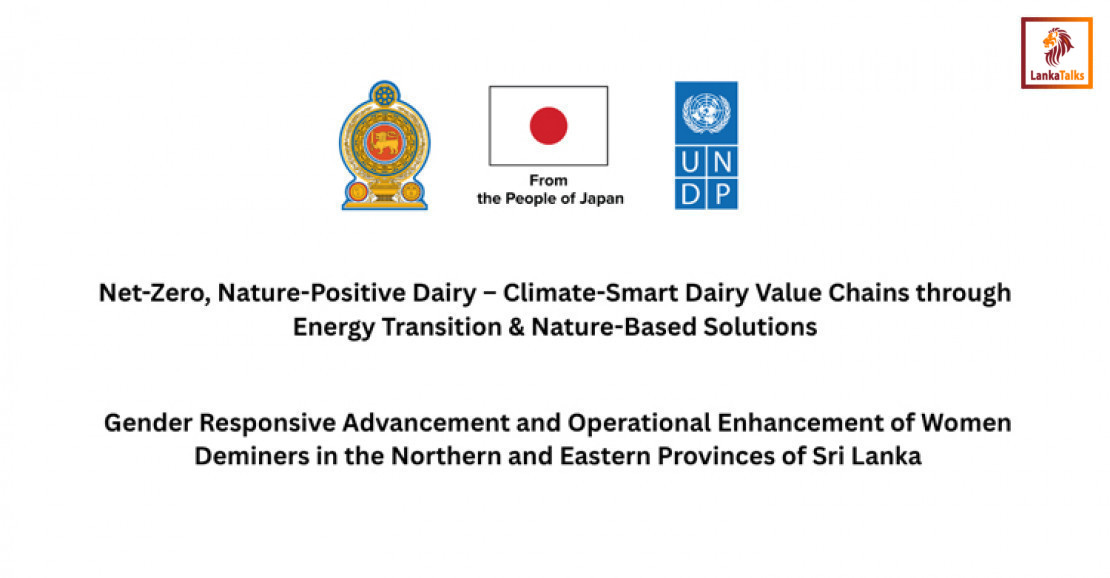
The first project titled ‘Net-Zero, Nature-Positive Dairy – Climate-Smart Dairy Value Chains through Energy Transition & Nature-Based Solutions’ establishes a Climate-Smart Dairy (CSD) ecosystem, integrating inclusive green technologies, sustainable farming practices, and market-driven solutions to reduce emissions, enhance dairy yield, and build adaptive capacity among vulnerable communities. Together with the Ministry of Rural Development and Social Security, Ministry of Agriculture and the Ministry of Energy for overall policy guidance, the initiative aims to directly benefit 750 smallholder farmers and indirectly reach over 5,000 people including family members, aspiring youth agri-entrepreneurs, veterinary officers, animal health professionals, local milk collectors, and other community members-particularly women and youth in the climate-vulnerable districts of Kilinochchi in the Northern Province and Nuwara Eliya in the Central Province, contributing to long-term livelihood and human security. With a funding envelope of USD 1.5 Million, the project builds on evidence and promising practices from previous initiatives, demonstrating the viability of renewable energy-based modernisation approaches for rural communities.
The second project titled, ‘Gender Responsive Advancement and Operational Enhancement of Women Deminers in the Northern and Eastern Provinces of Sri Lanka’ will further enhance the capacity and operational effectiveness of women deminers in Sri Lanka’s Northern and Eastern Provinces, with a particular focus on Kilinochchi and Mullaitivu. These districts remain among the most vulnerable in the country, according to UNDP’s 2023 Multidimensional Vulnerability Index, with vulnerability levels stand at 70% in Kilinochchi and 72% in Mullaitivu. The USD 1.16 Million project in partnership with the Ministry of Housing, Construction, and Water Supply, and in close collaboration with the existing mine clearance operators, empowers women to play a pivotal role in mine action, and aims to further promote greater gender equality and community development in regions deeply affected by multiple crisis including the past conflict, disaster and economic constraints. The project will support the deployment of advanced technologies to enhance the precision and efficiency of mine action operations. Through these efforts, the project aims to support greater efficiency in land clearance, facilitate resettlement, and enable sustainable livelihood recovery for the communities in the North and East of Sri Lanka.
These ongoing partnerships builds on evidence and promising practices, reaffirming UNDP and the Government of Japan’s commitment to supporting Sri Lanka’s transition to a climate-resilient, inclusive, and sustainable agricultural sector, empowering smallholder farmers and vulnerable communities to build resilient livelihoods and contribute to the nation’s net-zero development goals.
The projects, strengthen the capacity of women deminers in vulnerable districts, supporting enhanced safer land clearance, resettlement, and sustainable livelihoods, while enabling smallholder farmers to adopt climate-smart practices and green technologies, contributing to increased yields, reduced emissions, and enhanced human security. Together, these projects empower marginalised communities and drive progress towards Sri Lanka’s net-zero development goals and a more inclusive, sustainable future.
Source: Adaderana