


 Breaking News
 A.R.B.J Rajapaksha
 A.R.B.J Rajapaksha
 Feb 16 2026
 845
845Photo Captions:
Hon. Sunil Handunneththi, Minister of Industry and Entrepreneurship Development speaking at the Sri Lanka Franchise Expo 20
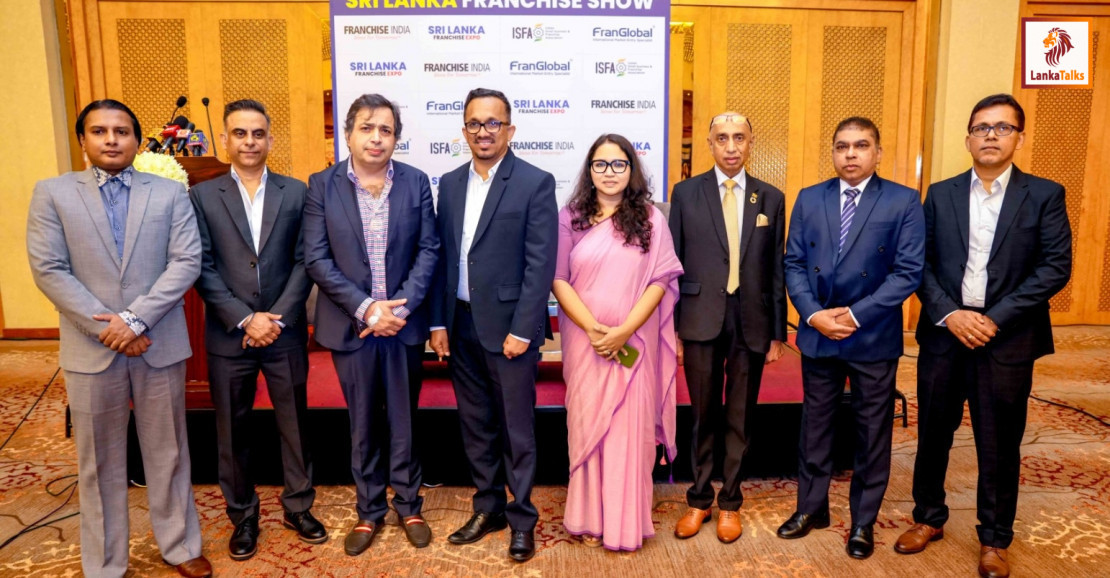
Seen here are the officials including from Franglobal
Sri Lanka's franchise sector attracted significant international attention at the recently held Sri Lanka Franchise Expo 2026, where over a dozen global brands explored expansion opportunities in what industry observers describe as South Asia's most strategically positioned franchise market.
One of the key highlights was also the signing of the agreement between Franglobal and Fat Crab, part of Don Stanley Holdings, expanding to India, specifically to the southern part with its rich seafood culture, with plans to expand to up to 25 outlets across the country by 2028, and later to Southeast Asia and Middle East region.
Held on 14th February at Marino Beach Hotel, Colombo, the expo brought together franchise principals from multiple continents with local entrepreneurs and investors seeking proven business models in an environment where traditional startup risks remain elevated.
The presence of Hon. Sunil Handunneththi, Minister of Industry and Entrepreneurship Development, who inaugurated the event, alongside Ms. Devika Lal, Counsellor and Head of Economic and Commercial Wing at India's High Commission, underscored the policy-level recognition that franchising represents structured economic development rather than conventional business expansion.
Minister Handunneththi noted: "We appreciate Franglobal bringing together brands, investors and industry leaders from Sri Lanka and India, especially at a time when our nation is strengthening its entrepreneurship and industrial development. Franchising is not merely a business model; it's a powerful vehicle for economic growth, innovation, employment generation, and SME development, including knowledge exchange and technology transfer. This event represents an exemplary opportunity to deepen the economic and commercial ties between our two countries."
Ms. Devika Lal observed: "India and Sri Lanka share exceptionally strong economic fundamentals. India is Sri Lanka's largest trading partner, second-largest export market, leading source of tourism, and last year, fifty percent of Sri Lanka's FDI came directly from India. The SME sector forms the backbone of both our economies, creating livelihoods, generating employment, and driving growth. This is an excellent time for bilateral investment, and events like the Franchise Expo are crucial in connecting our business communities and strengthening commercial cooperation between our two nations."
Six major chambers and industry bodies backed the initiative: Indo-Lanka Chamber of Commerce, Ceylon National Chamber of Industries, International Chamber of Commerce Sri Lanka, Colombo Chamber of Commerce, Federation of Chambers of Commerce and Industry of Sri Lanka, and Indian Small Business & Franchise Association. This convergence signals institutional consensus on franchising's economic multiplier potential.
International participants spanning coffee retail, fitness, professional services, and quick-service restaurants found an audience considerably more sophisticated than preliminary assessments suggested. The brands present (Stellarossa, EasyGym, Coffeeshop Company, Action Coach, U Clean, Blenz Coffee, Tea Avenue, Impasti Pizza, Burgertory, Figaro's Pizza, Barcelos, Yogurt Factory, and Orane International) represented sectors experiencing accelerated growth in Sri Lanka's urban centers.
Gaurav Marya, Chairman of Franchise India Group, whose organization has been working with Sri Lankan stakeholders since the April 2025 Global Franchise Forum, described the shift in market readiness. "What distinguishes Sri Lanka isn't just recovery metrics—it's the caliber of entrepreneurs approaching franchise opportunities. These are business operators with capital discipline, international exposure, and clear scaling roadmaps. That combination is relatively rare in emerging markets."
Several factors appear to be driving franchisor interest. Sri Lanka's 22 million population, while modest by regional standards, demonstrates concentrated purchasing power in urban corridors. The island's position between India and Southeast Asia offers geographic leverage. Legal frameworks around intellectual property and contract enforcement meet international standards. Tourism sector recovery is rebuilding foot traffic in commercial districts. And crucially, the local business community is demonstrating appetite for structured operational systems over speculative ventures.
From the franchisee perspective, the value proposition centers on risk mitigation. In markets where access to credit remains constrained and business mortality rates high, acquiring a validated operating model with brand recognition and supplier relationships substantially improves survival probability. For local investors accustomed to high-context, relationship-dependent business models, franchising offers standardized processes that can scale without proportional increases in management complexity.
The Ministry of Industry and Entrepreneurship Development's active involvement (not just ceremonial participation) indicates government recognition that franchise development can accelerate job creation and formalize business practices across sectors. This alignment between private sector activity and public policy creates conditions where sustained development becomes feasible rather than episodic.
The event's timing follows April 2025's Global Franchise Forum, which established initial dialogue between international brands and Sri Lankan stakeholders. The progression from exploratory discussions to concrete partnership negotiations within ten months suggests momentum that extends beyond event-driven interest.