


 Breaking News
 Puvanya
 Puvanya
 Oct 07 2026
 44
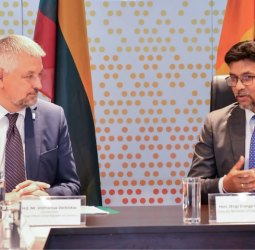
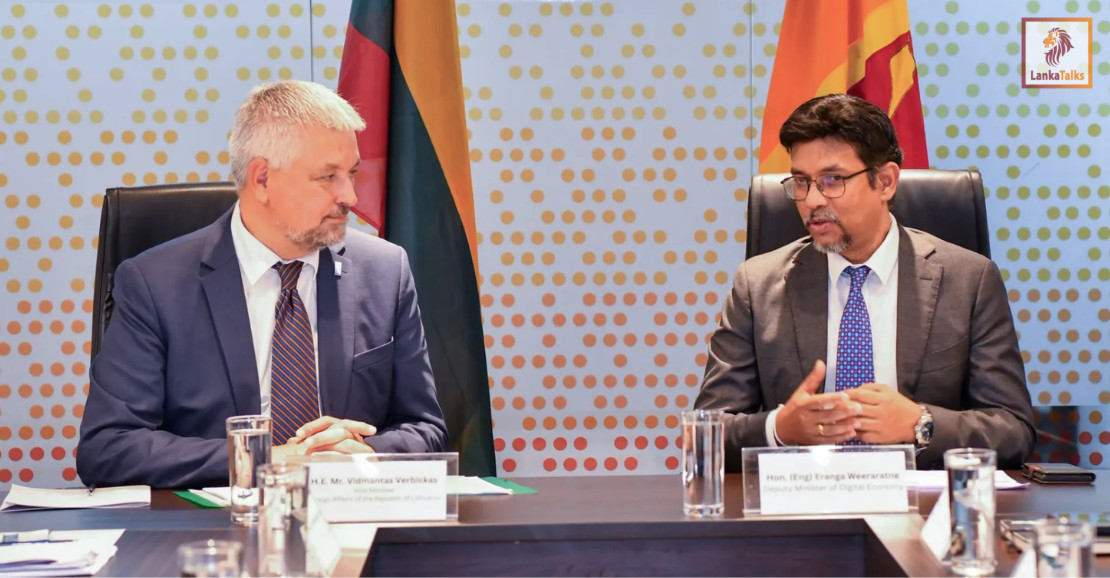
44Deputy Minister of Digital Economy Eng Eranga Weeraratne and Republic of Lithuania Vice-Minister of Foreign Affairs, Vidmantas Verbickas were engaged in a high-level bilateral discussion on Monday (5) to advance strategic cooperation across digital economy initiatives, technology transfer, and public sector digital transformation, according to an official statement.
During the meeting, Weeraratne commended Lithuania’s digital transformation journey and reaffirmed Sri Lanka’s commitment under its national Digital Economy Blueprint to achieve a $ 5 billion digital economy, driven by FinTech innovation and startup ecosystem acceleration as foundational pillars.
In response, Verbickas praised Sri Lanka’s ambitious digital roadmap, highlighting strong potential for both nations to serve as regional gateways through the exchange of policy expertise, technical skills, and tax frameworks that ease administrative burdens. He also extended an official invitation to the Government of Sri Lanka to participate in the upcoming Digital Tech Summit in Vilnius in 2027, focusing on AI, cybersecurity, and GovTech leadership.
The Lithuanian delegation shared key insights into their Open Government Data architecture, which enhances public sector transparency, and detailed Lithuania’s € 16.4 billion startup ecosystem supported by its globally recognised ‘GovTech Lab’ model, which bypasses traditional public procurement constraints to deliver private sector tech solutions to public domain challenges. Aligning with Sri Lanka’s national priorities to establish an AI Training Centre and upgrade its national Data Centre, both parties agreed to explore technical-level engagements to adapt Lithuania’s GovTech Lab framework to accelerate Sri Lanka’s public sector digitalisation.
Weeraratne outlined Sri Lanka’s roadmap toward implementing a national Digital ID by 2027 utilising open-source Digital Public Infrastructure (DPI) platforms, while the delegation shared lessons learned from Lithuania’s eID implementation regarding secure data governance and storage. Discussions also encompassed AI integration in education and telecom infrastructure, with the Deputy Minister noting that Sri Lanka has achieved 96% 5G network coverage while continuing to extend high-speed connectivity into rural regions.
To operationalise future partnership avenues, both nations agreed to initiate technical dialogues with Lithuania’s Communications Regulatory Authority (RRT) covering FinTech regulatory frameworks, Electronic Money Institution (EMI) licensing pathways, and private 5G experimental licensing, thereby deepening bilateral digital and cybersecurity ties.