


 Breaking News
 Krishani
 Krishani
 Nov 02 2026
 34
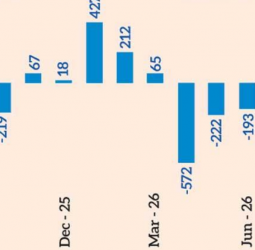
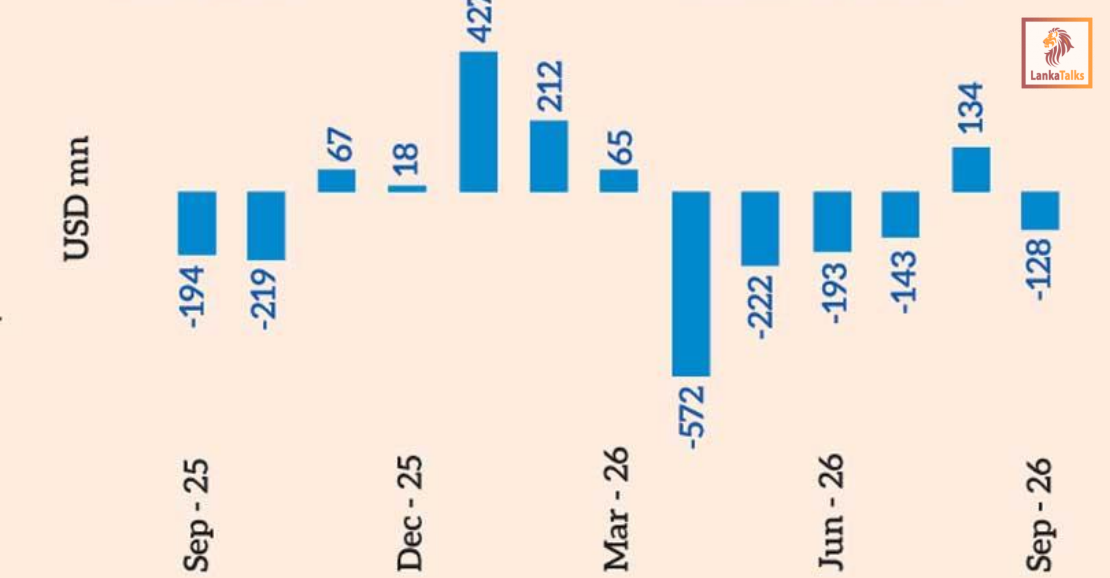
Sri Lanka’s external current account slipped back into a deficit of US$ 128 million in September, after a brief US$ 133 million surplus in August, taking the cumulative shortfall for the first nine months to US$ 420 million against a US$ 1.85 billion surplus a year earlier, Central Bank data showed.
The September deficit was the fifth recorded this year but the smallest of the five, well below the revised US$ 572 million shortfall in April, the first of the year. It was also narrower than the US$ 194 million deficit in September 2025, as a lower trade deficit and higher remittances outweighed a wider primary income deficit and a smaller services surplus.
Merchandise export earnings rose 21.0 percent year-on-year to US$ 1.38 billion during the month, the highest monthly figure on record and around US$ 75 million above the previous peak set in July 2025. The Export Development Board had earlier estimated September merchandise exports at US$ 1.39 billion. Import expenditure, meanwhile, rose a more modest 2.9 percent to US$ 2.11 billion. With exports far outpacing imports, the monthly trade deficit narrowed 19.6 percent to US$ 731 million from US$ 910 million a year earlier. However, the cumulative trade deficit widened 52.9 percent to US$ 7.91 billion during January-September from US$ 5.17 billion in the corresponding period of 2025. Import expenditure rose 21.3 percent to US$ 18.67 billion over the nine months, an increase of US$ 3.28 billion, while export earnings grew only 5.3 percent to US$ 10.75 billion.
Fuel, the largest single item in the country’s import basket, accounted for much of that increase. Cumulative fuel import expenditure rose 51.5 percent year-on-year to approximately US$ 4.5 billion during the nine months, roughly US$ 1.5 billion more than a year earlier, or nearly half of the total increase in import spending.
Fuel now makes up close to a quarter of the nine-month import bill, above the average share of around 20 percent it has held annually over the past decade, as per Central Bank data.
Monthly fuel spending has nonetheless eased, with expenditure declining for the fifth consecutive month in September. Fuel imports had peaked at US$ 886 million in April amid higher oil prices and import volumes following the outbreak of the Middle East conflict in late February, before moderating to US$ 536 million in May, US$ 465 million in June and US$ 453 million in July.
Expenditure on personal and commercial vehicle imports fell 34.4 percent year-on-year to US$ 188 million in September from US$ 286 million a year earlier. The September figure was broadly in line with the US$ 189 million spent in August and well below the US$ 241 million recorded in July.
Cumulative vehicle imports nevertheless reached US$ 1.87 billion during January-September, around 45 percent higher than the US$ 1.29 billion spent in the same period of 2025, when imports were only gradually resuming after the restrictions imposed in 2020 were lifted. Vehicles accounted for about a tenth of the nine-month import bill, and together with fuel they made up roughly a third of it.
Central Bank Governor Dr. Nandalal Weerasinghe has attributed the slowdown in vehicle imports to tighter loan-to-value rules and a government surcharge, noting that fewer letters of credit had been opened in recent months, which pointed to lower imports ahead. In May, he had warned that vehicle imports could reach about US$ 2.4 billion this year if the pace seen in the early months continued.
The terms of trade deteriorated both in September and over the nine months, as import prices rose faster than export prices, the Central Bank said.
The primary income deficit widened to US$ 241 million from US$ 152 million a year earlier, mainly due to higher dividend payments on direct investment, with direct investment income outflows more than doubling to US$ 191.5 million.
Workers’ remittances rose 5.6 percent year-on-year to US$ 734 million in September, slowing from 10.0 percent growth in August, but they were still sufficient on their own to offset the month’s trade deficit. Cumulative remittances increased 18.1 percent to US$ 6.87 billion during the nine months, although the Central Bank noted that the figure may include other inflows, such as those received following Cyclone Ditwah.
In contrast, the services account surplus fell 34.3 percent to US$ 119 million, as outflows rose 36.7 percent to US$ 441 million against an 11.2 percent increase in inflows to US$ 559 million. Overseas travel expenditure jumped 64.9 percent to US$ 122 million, equivalent to about two-thirds of what the country earned from tourism during the month. The cumulative services surplus declined 22.3 percent to US$ 2.21 billion.
Tourism earnings edged up 1.5 percent year-on-year to US$ 186 million in September, even as arrivals dipped 0.3 percent to 158,557. Over the nine months, earnings fell 9.2 percent to US$ 2.25 billion, while arrivals declined 1.8 percent to 1.69 million. The 2026 earnings estimates are based on a revised methodology introduced by the Sri Lanka Tourism Development Authority.
Foreign investment in government securities recorded a net outflow of US$ 39.9 million in September, compared with a net inflow of US$ 37.8 million a year earlier, while the Colombo Stock Exchange saw a net foreign outflow of US$ 4.7 million.
Gross official reserves, including the swap facility with the People’s Bank of China, remained at US$ 6.9 billion at end-September, equivalent to 3.3 months of imports. Meanwhile, the rupee had depreciated 6.8 percent against the US dollar on a year-to-date basis by end-October, with the dollar trading at Rs.332.61 compared to Rs.309.99 at end-2025, deepening from 5.5 percent at end-August and 6.3 percent at end-September.