


 Breaking News
 Krishani
 Krishani
 Oct 06 2026
 580
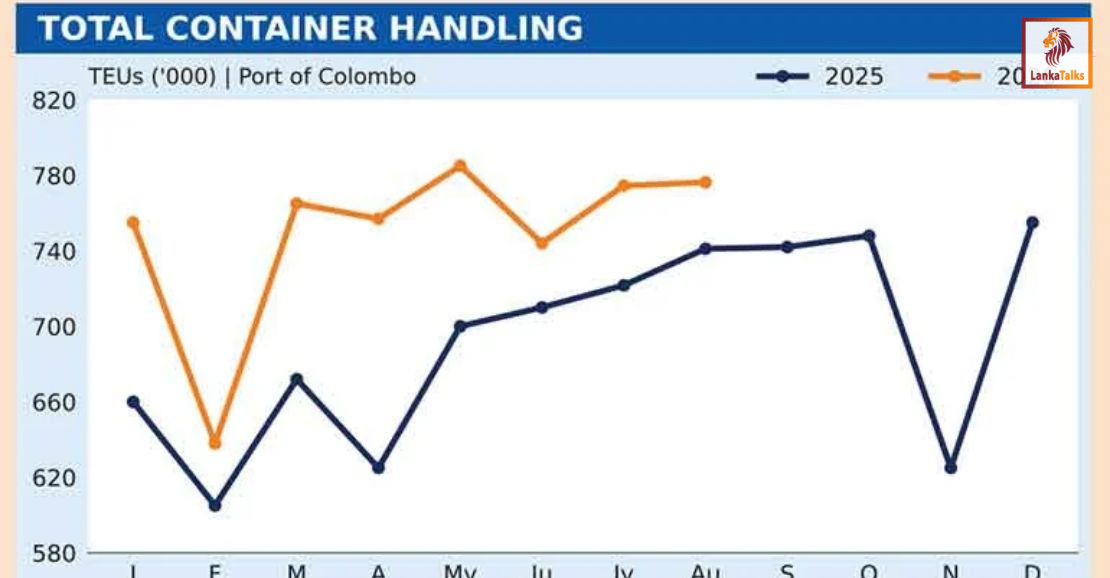
580Container volumes at the Port of Colombo rose 10.3% year-on-year (YoY) to 5.99 million twenty-foot equivalent units (TEUs) in the first eight months of 2026, driven by transshipment, Central Bank data showed, although domestic container traffic contracted sharply in August.
A TEU is the standard unit for measuring container capacity, equal to one 20-foot shipping container.
Total container handling at Colombo grew 4.7% YoY to 776,300 TEUs in August, from 741,124 TEUs a year earlier, according to Sri Lanka Ports Authority (SLPA) figures published by the Central Bank. The 2026 figures are provisional, while the 2025 figures have been revised.
Transshipment, the movement of containers through Colombo from one vessel to another en route to other markets, rose 7.8% YoY to 638,843 TEUs in August. For the January to August period, transshipment volumes increased 10.9% to 4.83 million TEUs. The segment accounted for 82% of the port's container volumes in August and 81% in the eight months.
In contrast, domestic container volumes, which serve Sri Lanka's own imports and exports, fell 12.5% YoY to 99,373 TEUs in August, from 113,615 TEUs a year earlier, a drop of 14,242 TEUs. Cumulative domestic volumes nonetheless grew 4.1% to 893,291 TEUs in the first eight months.