


 Breaking News
 Krishani
 Krishani
 Oct 20 2026
 35
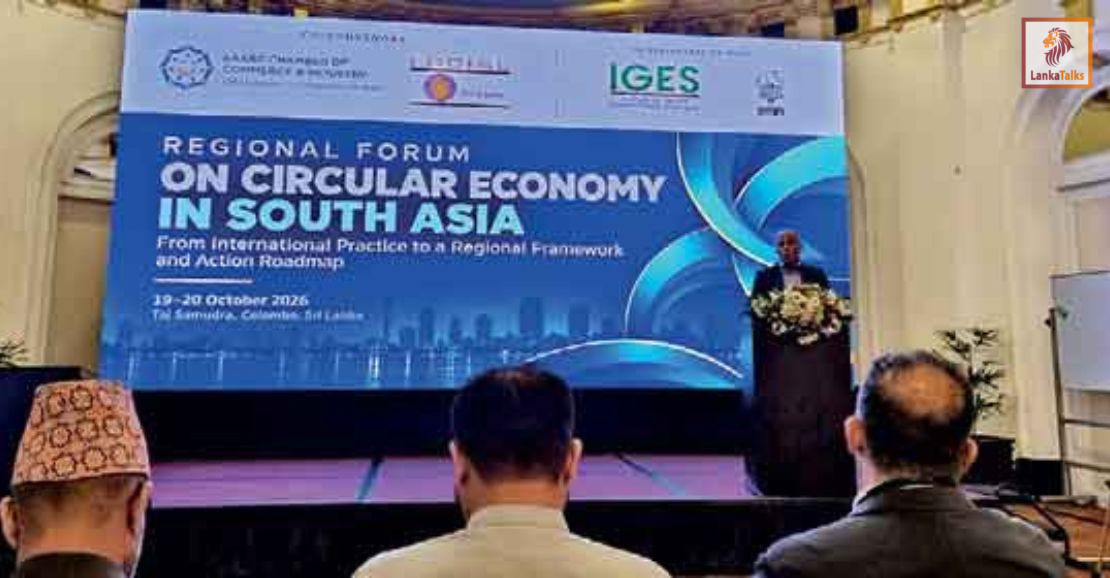
The Regional Forum on Circular Economy in South Asia enters its second and final day today (20), at the Taj Samudra, Colombo, with discussions scheduled on a regional framework and implementation roadmap for a resource-efficient, competitive and inclusive economy.
The Federation of Chambers of Commerce and Industry of Sri Lanka (FCCISL) President and SAARC Chamber of Commerce and Industry (SAARC-CCI) Senior Vice President Dr. Rohitha Silva delivered the opening remarks on 19 October.
Jointly convened by SAARC-CCI and FCCISL, the Regional Forum on Circular Economy in South Asia is organised in collaboration with the Institute for Global Environmental Strategies, through its Centre Collaborating with UNEP on Environmental Technologies (IGES-CCET), and HELP-O Sri Lanka.
Environment Minister Dr. Dammika Patabendi is scheduled to deliver today’s keynote address on enabling policies and supportive mechanisms for circular economy development. The first-day program listed keynote addresses by ESCAP’s Subregional Office for South and South-West Asia Director Mikiko Tanaka, participating online and Industry and Entrepreneurship Development Deputy Minister Chathuranga Abeysinghe.
Other dignitaries listed in the two-day program include Foreign Affairs Deputy Minister Arun Hemachandra, Embassy of Nepal Chargé d’Affaires a.i. Vijay Kumar Raut, and SAARC-CCI and FCCSIL former President Deshabandu Mackay Hashim.
Technical contributors included IGES-CCET Director Dr. Premakumara Jagath Dickella Gamaralalage, IGES and the Japan Partnership for Circular Economy Dr. Yasuhiko Hotta, Thammasat University Dr. René van Berkel, and IGES Research Director Dr. Ngoc-Bao Pham.
Under the theme “From International Practice to a Regional Framework and Action Roadmap”, the forum connects international experience with business opportunities and implementation priorities.
The circular economy retains the value of products and materials through better design, efficient resource use, maintenance, repair, reuse and recycling. These practices can reduce waste, improve productivity and create enterprise opportunities.
Six priority sectors are covered: textiles and ready-made garments; plastics and packaging; agriculture; electrical and electronic waste; construction and demolition; and tourism.
FCCISL State Affairs Committee Director and Chairman Ruwan De Silva emphasises the importance of linking circular economy initiatives with enterprise development, district economies, investment and inclusive growth.
The first-day program focused on experiences from Japan, ASEAN and other relevant contexts, alongside opportunities for youth, start-ups and women-led enterprises, with working sessions addressing financing, technology, standards and market barriers.
Today’s program will review the draft Framework for a Resilient and Inclusive Circular Economy in South Asia and refine its proposed 2026–2030 roadmap, including responsibilities, financing needs and milestones.
Participants will also consider a proposed SAARC-CCI Colombo Declaration on Circular Economy in South Asia, with further endorsement processes to follow.
Recognition of informal workers and waste collectors forms part of the proposed approach. The forum aims to translate regional cooperation into practical partnerships, investable projects and lasting benefits for businesses and communities.