



 Breaking News
 Krishani
 Krishani
 Oct 29 2026
 33
AI adoption is accelerating. Business value is not guaranteed. Competitive advantage will depend not on the AI tools organisations deploy, but on how effectively they transform operations, strengthen decision-making and deliver measurable returns.
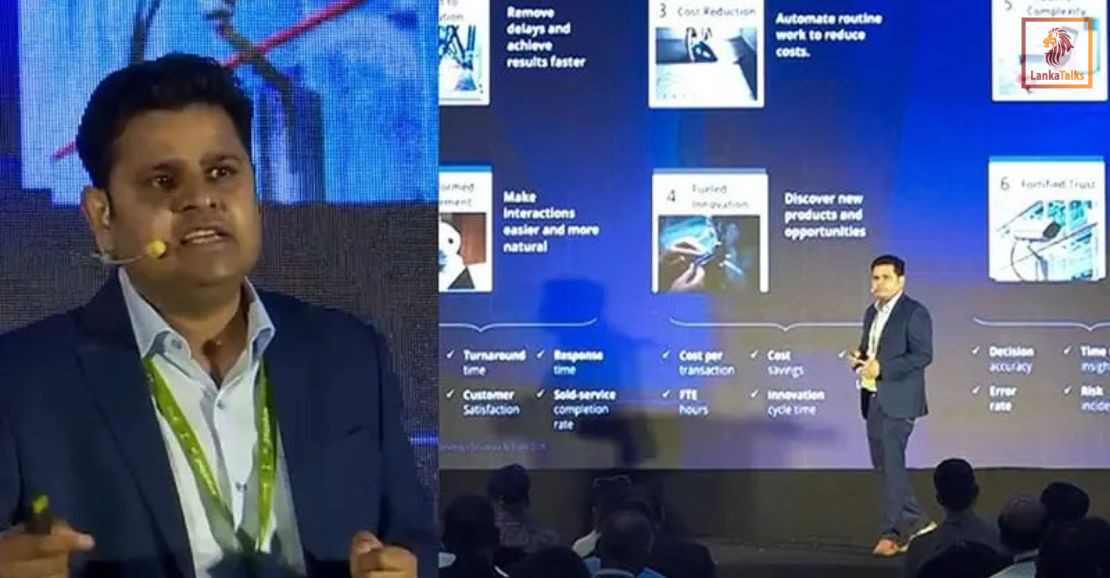
This shift was explored at the National AI Expo, held as part of Sri Lanka AI Week 2026 recently. Organised by Sri Lanka Telecom (SLT-MOBITEL) under the theme “National Vision and Implementation,” the event featured Varun Rastogi, Partner, AI & Data, Deloitte India. His session on AI for Business Strategy: ROI, Productivity and Copilots, examined what it takes to turn AI experimentation into enterprise value.
“As AI technologies standardise rapidly across industries, becoming an AI-fuelled organisation will likely be more than a strategy for success, but it could be table stakes for survival,” Varun noted.
This requires organisations to move beyond AI pilots and embed AI into core operations. Varun introduced the Desirability, Viability and Feasibility (DVF) framework to prioritise AI applications based on business need, potential value and implementation readiness. In insurance, AI can extract and validate claims information, check eligibility and accelerate settlements, reducing processing times to hours.
Varun stressed that AI returns should be measured through business outcomes, not experiments or model sophistication. He identified six areas of value: faster execution, stronger customer engagement, lower costs, innovation, reduced complexity, and improved risk detection and customer protection. In banking, AI can reduce the time required to analyse business loan applications from days to hours. AI-powered analytics can also give sales teams timely insights to guide commercial decisions.
AI returns are multiplicative rather than additive. Value depends on use case selection, AI autonomy, execution, data and technology foundations, and controls. Weakness in any one area can undermine the investment.
“A strong, interesting use case without having the right data set is not going to be useful. Similarly, strong technology, but there is no adoption, there is no change management, is not going to be relevant,” he explained.
Organisations must also decide how much responsibility AI should take within each process. Varun outlined four approaches, namely assist, augment, delegate and automate, to balance AI autonomy with human involvement.
“The objective here is not about replacing humans. The objective is primarily to identify the right balance of AI and human, machine and human intelligence, what we also call ‘human plus’, to take action and move ahead,” he emphasised.
Scaling AI requires leadership support, realistic success measures and regular stage gate reviews. He also highlighted the importance of speed, adaptability and recognising when simpler solutions are sufficient.
Adding to this perspective, Mayura Malagala, Human Capital Consulting, Engineering AI & Data and Growth Office Leader, Deloitte Sri Lanka & Maldives, emphasised the importance of workforce readiness in driving meaningful AI transformation.
“Organisations must rethink how work is done, develop new capabilities and build confidence in using AI responsibly. Without investing in people and preparing them for new ways of working, even the most promising AI initiatives may struggle to deliver sustainable business value.”, he noted.
The next phase of AI transformation will be defined by results, not adoption alone. Organisations that align AI investments with business priorities, strengthen governance and equip their people for change will be better positioned to translate innovation into measurable and lasting business impact.